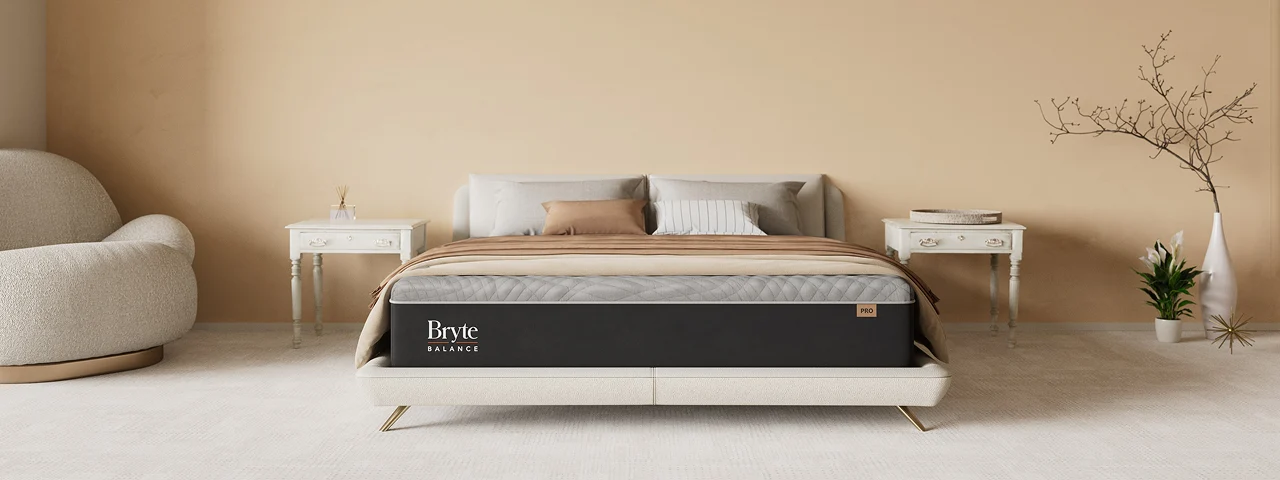
A smart mattress uses embedded sensors, powered adjustment systems, and AI software to actively monitor your body and adjust support throughout the night - without requiring you to wake up or make manual changes.
This represents a fundamental shift from traditional mattresses. Conventional mattresses - whether memory foam, innerspring, or hybrid - provide static support through passive material compression. They react to your body weight but cannot adapt when you change positions during sleep. A smart mattress detects pressure changes in real-time and redistributes support within seconds, addressing developing discomfort before it wakes you.
The distinction matters because of how sleep actually works. You shift positions dozens of times per night. Each transition creates new pressure points - shoulders and hips when you roll to your side, lumbar spine when you shift to your back. Traditional mattresses force these areas to wait for foam to slowly conform or springs to gradually compress. Smart mattresses actively soften or firm specific zones to match each new position immediately.
How Smart Mattresses Actually Work
Smart mattress technology operates through three integrated systems working continuously throughout the night:
1. Sensing Layer: Continuous Pressure and Biometric Detection
Embedded sensors map pressure distribution across hundreds or thousands of points on the sleep surface. High-resolution systems detect force changes measured in PSI (pounds per square inch), identifying even small imbalances before they become uncomfortable.
Beyond pressure mapping, ballistocardiography (BCG) sensors measure physiological signals through subtle body movements:
- Heart rate and respiration: 95% accuracy compared to medical equipment
- Sleep stage estimation: 78-93.4% accuracy versus polysomnography
- Total sleep time: 85-90% agreement with clinical measurements
2. Adjustment Architecture: Zones and Pneumatic Control
The adjustment mechanism uses precisely controlled pneumatic air chambers arranged in zones corresponding to body regions - shoulders, lumbar, hips, and legs.
Zone architecture varies dramatically between products:
Bryte's Adaptive Core exemplifies high-resolution design: up to 90 individual foam-wrapped air modules (Balancers) arranged across 16 independent zones - 8 per sleeper. This granularity enables the mattress to soften specifically under your hip while maintaining firmer support under your lower back simultaneously.
3. AI Learning: Personalization That Improves Over Time
Machine learning algorithms analyze sleep data to identify patterns and optimize adjustments for each individual. Rather than applying generic settings, these systems learn:
- Which firmness levels correlate with longer uninterrupted sleep periods
- How your body responds to different position-support combinations
- What adjustments reduce morning stiffness or pain
Bryte's Restorative-AI platform continuously refines recommendations based on accumulated sleep data. The Bryte OS software platform delivers over-the-air updates, meaning the mattress literally improves its performance over time without hardware changes.
Active Pressure Relief: The Technology That Defines Smart Mattresses
Active Pressure Relief requires two simultaneous capabilities: real-time sensing of pressure distribution AND real-time adjustment in response. Both must work continuously without sleeper input.
This definition matters because it distinguishes genuine smart technology from products offering only manual adjustability. A mattress that lets you change firmness through an app - then maintains that fixed setting - provides adjustability, not Active Pressure Relief. The "real-time" requirement is critical: if adjustments happen only when you initiate them, the mattress cannot preemptively address pressure points developing while you sleep.
The Three Markers of True Active Technology
When evaluating any smart mattress, three technical characteristics determine whether it delivers meaningful real-time adjustment:
1. Sound Level
Active adjustment defeats its purpose if the mechanism wakes you. Effective systems use silent or near-silent pneumatics. Bryte's Active Pressure Relief operates through virtually noiseless pneumatics - engineering that required significant investment but ensures adjustments happen without disturbing sleep. If a mattress is noisy during adjustments, it defeats the very purpose of nighttime optimization.
2. Sensing Resolution
Low-resolution systems treat each side as a single zone, making uniform adjustments regardless of where pressure actually builds. High-resolution systems use multiple independent zones with hundreds of sensing points. Bryte's 90 individual Balancers across 16 zones enable targeted relief impossible with single-bladder designs - softening specifically under your shoulder while maintaining lumbar support. The contrast is stark: a single air bladder for an entire body cannot address specific pressure points the way high-resolution zone architecture can.
3. Response Time
Pressure points develop within seconds of position changes. Systems adjusting on fixed intervals (once per hour, for example) cannot address continuous small movements throughout a typical night. True Active Pressure Relief systems respond within seconds. Bryte adjusts in real-time, ensuring that each position shift receives immediate support optimization rather than waiting for a scheduled adjustment cycle.
Smart Mattress vs. Traditional Mattress
When Traditional Mattresses Make Sense
Not everyone needs active technology. Traditional mattresses may be sufficient if you:
- Sleep well consistently and wake feeling rested
- Maintain similar positions throughout the night
- Sleep alone without partner disturbance issues
- Prefer simple products without technology dependencies
- Have budget constraints where the premium creates strain
When Smart Mattresses Provide Clear Value
Active Pressure Relief shows strongest results for specific challenges:
- Chronic sleep-related pain: Clinical evidence shows pain severity scores dropping from 1.83 to 0.74 with pressure-relieving technology
- Partner conflicts: Different firmness preferences, different schedules, motion transfer complaints
- Frequent position changes: Combination sleepers shifting between back, side, and stomach positions
- Sleep onset difficulty: Relaxation features addressing anxiety or racing thoughts
The challenge of finding the right mattress for back pain resonates strongly with sleepers who have tried multiple options. As one user shared on r/Mattress:
"I spent years waking up with a stiff lower back, thinking it was just part of getting older or maybe a side effect of my gym routine. It took me way too long to realize my bed was actually the culprit. It's wild how a mattress can look perfectly fine on the surface while the internal support has completely degraded. I learned that once you start seeing those subtle sags or dips, your spine is basically fighting for its life all night."
Clinical Evidence: What Research Shows
Sleep Quality Improvements
An 8-week study of 39 adults with poor sleep quality documented statistically significant improvements:
- Pittsburgh Sleep Quality Index: Improved from 7.49 to 4.92 (p < 0.001) - crossing from clinically poor sleep into the good sleep range
- Insomnia Severity Index: Reduced from 12.11 to 7.05 (p < 0.001)
- Restorative sleep scores: Increased from 49.77 to 64.71 (p < 0.001)
Bryte users report a 46% improvement in restorative sleep - consistent with broader clinical findings on Active Pressure Relief technology.
Pain Reduction
The same clinical study found:
- Pain severity: Reduced from 1.83 to 0.74 on the Brief Pain Inventory
- Daytime fatigue: Decreased from 17.43 to 12.84
- Mood improvements: Tension scores dropped from 7.35 to 4.03; fatigue from 8.46 to 4.59
The mechanism: Active Pressure Relief prevents sustained pressure concentration at shoulders, hips, and lumbar spine. Rather than waiting for passive foam compression, the mattress redistributes load before discomfort triggers micro-awakenings or restless movement.
What Smart Mattresses Cannot Do
Honest limitations buyers should understand:
- Cannot diagnose sleep disorders - they flag potential concerns for professional evaluation, not clinical diagnosis
- Cannot measure blood oxygen (SpO2) - requires pulse oximetry through finger clips or wearables
- Cannot measure brain waves (EEG) - sleep stage estimation uses proxy measurements, not direct neural activity
- Best understood as longitudinal monitoring - complements rather than replaces clinical evaluation when health concerns arise
The limitations of consumer-grade sleep tracking are well understood among users. As one user noted on r/GarminWatches:
"My experience is that the sleep duration and sleep score are quite accurate reflections of how I feel. However, as far as I know, watches can't accurately track sleep stages (deep sleep, REM, etc.) since that would require measuring brain activity to be precise"
The Couples Advantage
Partner disturbance is a documented, widespread problem. 31% of U.S. adults have opted for "sleep divorce" - sleeping separately to get better rest. Even more striking: 44% of people sharing beds say sleep issues have caused them to question their relationship.
How Dual-Zone Technology Eliminates Compromise
Bryte's Dual Comfort Design addresses this directly:
- Independent firmness control: Each partner adjusts their side on a 0-100 scale - one partner at 30, the other at 70, without compromise
- Separate relaxation programs: Each side runs independent BryteWaves sessions with different audio tracks
- Individual sleep data: Each partner views their own metrics and recommendations
- Silent Wake Assist: Gradual motion wakes one partner without audible alarms disturbing the other
For couples where one partner moves frequently, the Bryte Balance PRO Conform uses high-density gel-infused memory foam for superior motion isolation - preventing restless movement from transferring across the sleep surface.
The struggle couples face when they have different firmness preferences is a common theme in mattress discussions. One Reddit user shared their experience on r/Mattress:
"Split king!! That's what we do. I'm female 125lbs and my partner is male 172lbs. It's made a massive difference to my quality sleep, I sleep like an angel now!!! Sleep is super important to your physical health, mental health, and relationship health. I never ever wake up sore at all anymore, it's the best!! I hated our previous mattress I couldn't sleep and was sore all the time, which took a toll on my mental health too and the relationship. I was cranky like all the time."
Privacy and Data Security
What Smart Mattresses Collect
Smart mattresses gather substantial personal data:
- Sleep timing, duration, and movement patterns
- Heart rate, breathing rate, heart rate variability
- Estimated sleep stages and restlessness metrics
- Environmental data (room temperature, ambient noise in some systems)
This data transmits from the mattress to manufacturer servers via home Wi-Fi. Storage and access policies vary significantly by brand.
Known Security Concerns
Security researchers have discovered concerning vulnerabilities:
- Hidden "backdoor" access points allowing manufacturer remote access without user notification
- Sleep data not federally protected like medical information under HIPAA
- Raw pressure/movement data can be analyzed to infer intimate activity patterns
Questions to Ask Before Buying
- What specific data does the system collect?
- Where is data stored - on-device, company servers, or third-party cloud?
- Can you opt out of data collection while retaining core functionality?
- What happens to your data if the company is acquired or discontinues service?
Reliability and Technology Concerns
Cloud Dependency Reality
Smart mattress features vary in connectivity requirements. Basic firmness settings typically work offline once configured. Advanced features - AI optimization, sleep analysis, remote control - usually require connectivity.
When evaluating options, consider what functionality remains if connectivity is lost.
App Experience Varies
User reviews across brands note common friction points: clunky interfaces, adjustment delays, Wi-Fi disconnects requiring resets. Check recent app store reviews for any brand you're considering.
Bryte's Sleep Concierge, built on GPT-4, allows users to text personalized questions that instruct the mattress to make targeted adjustments - simplifying interaction beyond traditional app controls.
Subscription Models
Some smart mattresses require monthly fees ($15-30+) for full functionality. Bryte does not require a subscription - all features are included with purchase, and Bryte OS delivers ongoing software improvements at no additional cost.
True Cost of Ownership
Price Comparison
The Per-Night Calculation
Annualized over an 8-year lifespan:
- $5,000 smart mattress: ~$1.71/night
- $1,500 traditional mattress: ~$0.51/night
- Premium difference: ~$1.20/night
The question becomes: Is $1.20 per night worth potentially resolving chronic pain, partner conflicts, or sleep anxiety affecting daily function?
Factors Affecting Value
Strong value indicators:
- Chronic sleep-related pain unresolved by previous mattresses
- Significant partner preference conflicts
- Interest in ongoing sleep data for health optimization
- HSA/FSA eligibility (Bryte qualifies)
Weaker value indicators:
- Generally good sleep without major complaints
- Single sleeper status
- Tight budget where premium creates financial strain
- Significant data privacy concerns
Many people with chronic back pain have cycled through multiple mattresses searching for relief. This experience was well captured by a user on r/BuyItForLife:
"Absolutely avoid any bed in a box. If you think that something can be vacuum sealed to 1/10th its size yet somehow remain supportive over time you're kidding yourself. Expect to spend an hour or more test driving mattresses."
Frequently Asked Questions
What's the difference between a smart mattress and an adjustable mattress?
Answer: A smart mattress automatically senses pressure and adjusts firmness in real-time without your input. An adjustable mattress lets you manually change settings, then maintains that fixed configuration until you change it again.
Key distinction:
- Smart: Continuous automatic adjustment throughout the night
- Adjustable: Manual setting that stays static until you intervene
How accurate is smart mattress sleep tracking?
Answer: Clinical validation shows smart mattresses achieve 85-95% accuracy compared to medical equipment for most metrics.
Accuracy by metric:
- Heart rate/respiration: 95% vs. medical equipment
- Total sleep time: 85-90% vs. polysomnography
- Sleep stages: 78-93.4% vs. clinical standards
Do smart mattresses require a subscription?
Answer: Some brands charge $15-30+ monthly for full functionality. Bryte does not require a subscription - all features are included with purchase, and software updates are delivered free through Bryte OS.
What happens if a smart mattress loses internet connection?
Answer: Basic firmness settings typically remain functional offline. Advanced features like AI optimization and app control usually require connectivity. Bryte maintains core adjustment functionality locally while using cloud connectivity for enhanced features.
Are smart mattresses worth the price?
Answer: The premium translates to roughly $1.20/night over an 8-year lifespan. Value depends on whether your specific sleep challenges - chronic pain, partner disturbance, frequent position changes - match Active Pressure Relief capabilities.
Best candidates: People with documented sleep-related pain, couples with different preferences, combination sleepers.
How long do smart mattresses last?
Answer: 7-10 years for mattress materials - similar to traditional mattresses. Bryte offers a 10-year warranty with 4-year coverage on technology components.
Can couples with different firmness preferences share a smart mattress?
Answer: Yes. Dual-zone systems like Bryte's Dual Comfort Design allow each partner to independently control their side's firmness (0-100 scale), run separate relaxation programs, and view individual sleep data - eliminating the need for compromise.
Making the Decision
Smart mattresses aren't universally superior to traditional options. They're specialized technology addressing specific problems. The decision framework is straightforward:
Choose a smart mattress if:
- You experience chronic sleep-related pain that hasn't responded to previous mattresses
- Partner disturbance significantly affects your sleep quality
- You shift positions frequently throughout the night
- You value ongoing sleep data for health optimization
- You're comfortable with connected technology and its data implications
Choose a traditional mattress if:
- You sleep well consistently without major complaints
- You maintain similar sleep positions throughout the night
- Budget constraints make the premium impractical
- You prefer simple products without technology dependencies
For those whose challenges align with Active Pressure Relief capabilities, the technology can transform sleep quality. For those without those specific challenges, a well-chosen traditional mattress may serve equally well at a fraction of the cost.
The Bryte product lineup offers options across the spectrum: the Bryte Balance for balanced support, the Bryte Balance PRO for advanced personalization, and the Bryte Balance PRO Conform for those prioritizing motion isolation. All include 100-night trials, allowing you to evaluate whether the technology addresses your specific sleep challenges before committing.
Shop Bryte Beds
From the Park Hyatt New York to Rosewood Miramar Beach, thousands of guests have experienced Bryte in the world’s top hotels—now it’s your turn.