The best mattress for couples with different sleep preferences is one with independent dual-zone control that allows each partner to set their own firmness level. For couples seeking active adjustment that adapts throughout the night, smart beds with real-time pressure sensing - like Bryte's 16-zone system - prevent the compromises that leave both partners dissatisfied. For couples wanting simpler independence, split king configurations allow completely different mattresses but create a physical gap between sleepers.
Quick Summary: Finding the Right Mattress When You and Your Partner Disagree
- The math is against you: 51% of Americans prefer firm mattresses, 49% prefer soft - giving any couple roughly a 50-50 chance of being mismatched
- "Compromise" mattresses fail both partners: A medium-firm bed designed to satisfy everyone typically leaves neither person properly supported
- Three solution categories exist: Traditional compromise (cheapest, least effective), split king (independence with physical separation), and Active Pressure Relief technology (independence without separation)
- Active Pressure Relief differs from adjustable firmness: True Active Pressure Relief provides real-time sensing and real-time adjustment and removal of pressure points - not just manual firmness controls
- Evaluation criteria that matter: Sound (must be silent), resolution (zone count determines precision), and response time (seconds, not hours)
Why Compromise Mattresses Fail Couples
The firmness split between partners is nearly inevitable. According to Better Sleep Council survey data, 51% of Americans prefer a firm or very firm mattress, while 49% prefer soft or very soft. Any two people sharing a bed have approximately a coin-flip chance of wanting completely different firmness levels.
This creates measurable friction. A Saatva Sleep Habits of Couples Survey of 1,500 people found that 35% of couples argue about mattress firmness. The breakdown reveals why agreement is so difficult:
- 12% prefer firm
- 30% prefer plush
- 58% prefer firm support with plush top
Nearly 30% have considered pushing twin mattresses together as a workaround.
The frustration is real. As one user on r/Mattress described their situation:
"My fiance and I have wildly different sleeping preferences - he likes firm and memory foam, while I like soft and pillowtop. We got a Sleep Number bed because you can set each side of the bed to what you want, but neither of us like it. When I lower the sleep number setting to make the bed "softer", it just deflates and provides no support."
The "Meet in the Middle" Approach Doesn't Work
Standard advice suggests compromising on medium-firm. This assumes both partners will be equally satisfied with a middle ground. In practice, medium-firm often means neither person gets what they need.
Your firmness needs aren't arbitrary preferences - they're driven by physics:
Research from Twilight Bedding confirms that heavier partners compress mattress comfort layers more deeply and engage the support core earlier than lighter partners. One side craters while the other stays flat.
The Real Costs of Sleeping on the Wrong Firmness
28.7% of US adults report mattress-related pain on waking, according to a Frontiers in Sleep study - 18.2% slight, 8.0% moderate, 2.4% severe.
The damage extends beyond physical discomfort. Research published in Affective Science found that poor sleep quality is associated with individuals reporting providing less support to their partner and perceiving less support from them. A meta-analysis cited by The Cardiology Advisor found:
- Better relationship quality correlates with better sleep quality (r=0.34)
- Higher satisfaction correlates with longer sleep duration (r=0.39)
When mattress incompatibility persists, couples increasingly choose separation. According to a 2025 American Academy of Sleep Medicine survey, 31% of US adults now engage in "sleep divorce." The rate hits 39% among adults aged 35-44. A Sleep Foundation survey found that 52.9% of sleep divorce adopters report improved sleep quality and average 37 extra minutes of sleep per night.
Sleep divorce works for sleep quality. But it trades rest for intimacy.
Traditional Solutions and Their Limitations
Split King: Independence with a Gap
Split king configurations use two Twin XL mattresses side by side. Each partner selects their preferred firmness independently. According to Sleep Foundation, prices typically range $1,000-$4,000, averaging around $2,400 for premium models.
The trade-off: A physical gap between sleepers. This center ridge creates separation that affects couples who prefer physical closeness or frequently shift positions. The two mattresses may also drift apart over time.
Reddit users frequently discuss this issue. One user on r/Mattress shared their experience after trying a split king:
"I had a king mattress, got adjustable bases and wanted to do a split king. My brother warned me against it, said he hated the split down the middle. My parents said the same thing he did. I did the split king anyway, hated it, and went back to king. Luckily it was a DIY mattress so all I had to do was change out the twinxl encasements to a king encasement. The split down the middle gets wider if you don't have "mattress stoppers" on the sides of the bed. I ordered some from amazon and that stopped the split from getting bigger, but it was still like I was sleeping in a college dorm on a twin mattress. Adult time was also awkward, sometimes your knee or leg goes into the split, and you both have to basically stay on one side of the mattress. I HATED it. Never ever again will I do a split king!"
Split kings work for couples with dramatically different preferences who don't prioritize sleeping in contact. For everyone else, they represent an incomplete solution.
Why Static Solutions Can't Solve Dynamic Problems
Traditional mattresses - split or unified - share a fundamental limitation: they're static. You select a firmness level. That setting remains constant for 8 hours.
Your body's support needs aren't constant. As you move through sleep cycles and change positions throughout the night, different pressure points become active. A firmness that feels comfortable when you fall asleep on your back may create pressure when you shift to your side at 3 AM.
This explains why couples find their mattress comfortable initially but wake up sore. The mattress worked for their starting position but couldn't adapt as needs changed. Selecting a single firmness for 8 hours assumes support requirements remain identical the entire time.
That's not how sleep works.
Mattress Options for Couples: A Direct Comparison
Understanding Active Pressure Relief Technology
What Separates Active Pressure Relief from Adjustable Firmness
Active Pressure Relief is defined by two requirements: real-time sensing of pressure points and real-time adjustment to address them.
This distinction matters. A mattress that lets you manually select firmness from an app is adjustable - but not active. Active Pressure Relief means the bed continuously monitors pressure points and automatically adjusts throughout the night without requiring you to wake up and change settings.
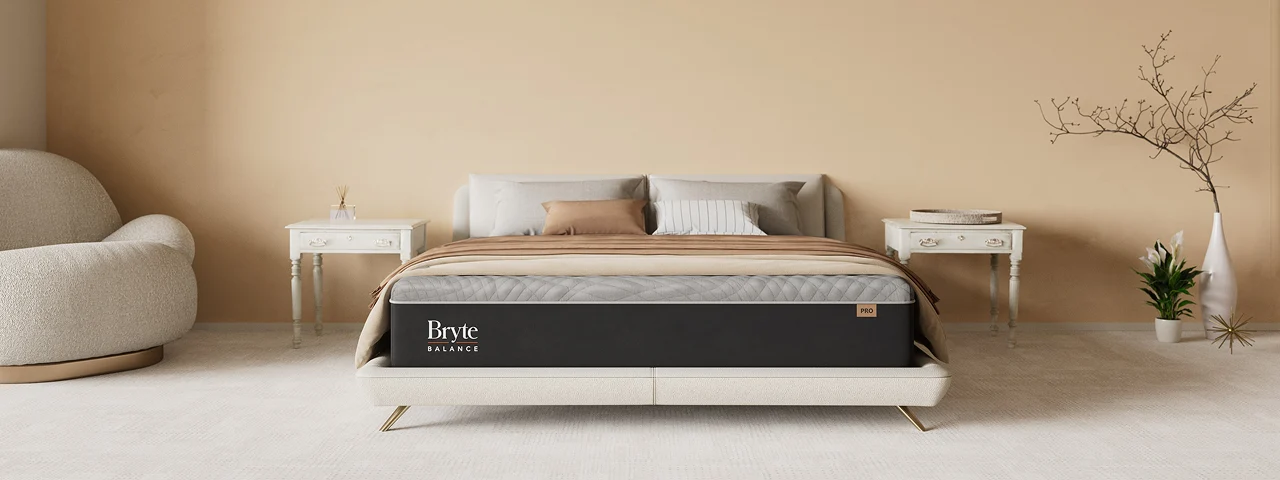
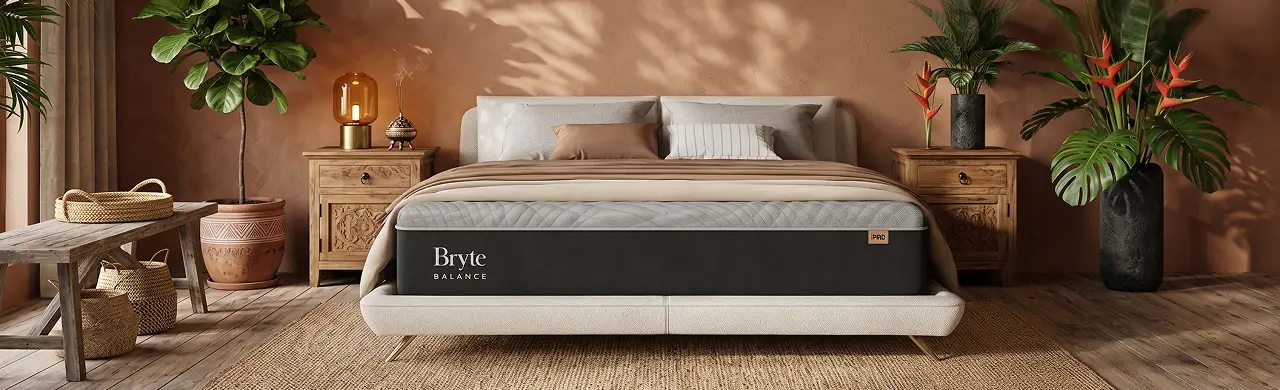
Bryte's Active Pressure Relief technology uses an Adaptive Core with up to 90 intelligent, pneumatic Balancers organized into 16 independent zones - 8 per sleeper. These sensors detect pressure and silently adjust firmness in real-time, within seconds of detecting an imbalance.
How Active Beds Eliminate the Need for Compromise
Active mattresses with dual-zone designs provide genuinely different firmness experiences to each partner on the same surface - no physical split required.
Bryte's Dual Comfort Design:
- Each partner independently controls their side's firmness (0-100 scale)
- Partner A can select soft while Partner B selects firm - simultaneously maintained
- Beyond baseline settings, the bed makes automatic micro-adjustments throughout the night as each person moves
The Bryte Balance and Bryte Balance PRO models feature this independent zone control. PRO models add Individual Zone Control for specific areas like the lower back, plus "Contours" - tailored profiles optimized for back, side, or stomach sleepers.
Motion Transfer: Prevention Beats Isolation
The Scale of Partner Disturbance
According to a OnePoll survey, 82% of people in relationships report their partner's sleeping habits consistently wake them up at night. Tossing and turning accounts for 25% of these disturbances.
A Sleepopolis survey found that 56% of people are woken by their partner two nights per week or more. Research in PubMed documented an average of 6 partner-induced awakenings per night, with 18.9% wake transmissibility.
One user on r/sleep described the impact partner movement has on sleep quality:
"A split king bed would work for tossing and turning. As long as snoring is not an issue. I am so regretting not getting one when we replaced our foam last year. Husband wanted conventional mattress but talked me out of the split king. The difference in motion is dramatic😢. I know every time he rolls over."
Why Active Pressure Relief Reduces Motion at the Source
Traditional approaches focus on motion isolation - using materials like memory foam to absorb movement after it happens. This is reactive.
A more effective approach: prevent the movement from occurring.
Much tossing and turning originates from pressure-point discomfort. When support is inadequate, sleepers shift positions seeking relief. Well-supported sleepers move less because they're not experiencing the pressure buildup that triggers repositioning.
Active Pressure Relief detects pressure imbalances and adjusts support before discomfort causes movement. Prevention is more effective than isolation.
Bryte's Silent Wake Assist feature demonstrates this philosophy in action - using gradual motion to wake one partner without an audible alarm, ensuring the other remains undisturbed.
The Three Critical Metrics for Evaluating Active Mattresses
Not all "active" or "smart" beds are equal. These three metrics separate effective Active Pressure Relief from marketing claims:
1. Sound: Silent Operation Is Non-Negotiable
If the bed makes noise during adjustments, it defeats the purpose. The goal is preventing wake events, not creating new ones.
What to test: Listen for motors, pumps, or air systems during adjustment. Any audible sound means the mechanism may disturb sleep during automatic corrections.
Bryte's pneumatic Balancers operate silently, ensuring adjustments happen without waking either partner.
2. Resolution: Zone Count Determines Precision
Resolution refers to how precisely the mattress can sense and adjust across different body areas. A single-bladder system treats your entire body as one zone - it can't address your lower back differently than your shoulders.
The comparison:
- Low resolution: Single air bladder per side (adjusts overall firmness only)
- High resolution: Bryte's 90 Balancers in 16 independent zones provide different support to shoulders, mid-back, lower back, hips, and legs simultaneously
Higher resolution means targeted support where individual pressure points require it.
3. Response Time: What "Real-Time" Actually Means
A bed that adjusts once per hour is technically "active" but can't prevent the pressure buildup that wakes you or triggers position shifts.
True real-time: Response within seconds of detecting pressure change. This addresses emerging discomfort before it reaches the threshold that triggers movement or waking.
Bryte adjusts within seconds. Systems that check hourly are reactive, not preventive.
Firmness Recommendations by Sleep Position and Weight
Use this as a starting point before testing:
Body weight adjustments:
- Under 130 lbs: Go 1-2 points softer than baseline
- 130-230 lbs: Use baseline recommendations
- Over 230 lbs: Go 1-2 points firmer than baseline
With Bryte's Guided Comfort Tailoring, AI recommends firmness settings based on body attributes and sleep data - eliminating guesswork.
Which Bryte Model Fits Your Situation
All models feature Active Pressure Relief, Dual Comfort Design with independent 0-100 firmness control per side, BryteWaves immersive relaxation, daily sleep insights via the Bryte app, and over-the-air software updates.
Price Ranges by Solution Type
According to Market Research Future, the smart mattress market is valued at $1.72 billion in 2025 and projected to reach $4.84 billion by 2035 - reflecting growing recognition that technology solves problems static materials cannot.
A Parks Associates study found 69% of consumers are willing to pay a 20% premium for mattresses with embedded sleep sensors.
Why Trial Periods Matter More for Couples
Couples have more complex evaluation needs than individual buyers. Both partners must adjust, and their individual adjustment periods may not align. Problems invisible in week one may surface in week four.
Furniture Today reports bed-in-a-box return rates around 7% - more than triple the 2.2% at specialty retailers. Online returns range 4-20% depending on brand.
The challenge of finding the right mattress as a couple is palpable in online discussions. As one user on r/Mattress expressed:
"Split king on adjustable base are nightmare. Adjustable bases need sheets like Dreamtime or Temperpedic with the big elastic corner straps (patented) these are expensive and split king is 2x. Changing fitted split sheets is crazy hard on middle edges. Split king you have 4 edges of mattress to break down. Giant valley in the middle, and the mattresses slide all over when sexually active. I went through 2 sets of expensive split king matteress on my ergomotion bases before i put adapter to make bases act as one not independently. This is one of those expensive life lessons that sounded good in theory but real life was BAD idea."
How to use a trial period effectively:
- Commit to the full trial - don't decide in the first week
- Track each partner's sleep quality independently
- Note morning pain, disturbance frequency, and temperature issues
- Evaluate both individual sleep and how you sleep together
- Adjust settings at 2-week intervals, not daily
The Long-Term Value Calculation
Traditional mattresses are static purchases: you get what you buy, and it remains unchanged until replacement. Technology beds with software updates can improve over time.
Bryte's platform delivers over-the-air updates without hardware replacement. The bed you own in year three may have capabilities that didn't exist when you purchased it.
Average mattress lifespan runs 7-10 years according to Saatva. Couples who cycle through compromise mattresses - replacing them when compromise becomes intolerable - may purchase multiple beds over the same period a single technology bed remains functional and improving.
The calculation: total cost of continuing to replace unsatisfactory mattresses vs. a single investment in technology that adapts to both partners' needs.
Frequently Asked Questions
What is the best mattress for couples with different firmness preferences?
Answer: A dual-zone smart bed with Active Pressure Relief that allows each partner to independently control their side's firmness. For automatic, real-time adjustment, Bryte's 16-zone, 90 balancer system provides the highest resolution available.
Key features to prioritize:
- Independent firmness control (0-100 scale per side)
- Active pressure relief with real-time sensing and adjustment
- Silent operation during adjustments
Is a split king better than a dual-firmness smart bed?
Answer: Split kings provide complete independence but create a physical gap. Dual-firmness smart beds provide independence without separation, keeping partners on a continuous surface.
Choose split king if:
- Preferences are dramatically different
- Physical closeness during sleep isn't a priority
Choose dual-firmness smart bed if:
- You want independence without sacrificing intimacy
- You want adaptive support throughout the night
How do smart beds handle couples with different preferences?
Answer: Smart beds use independent zones for each side, typically controlled via app. Each partner sets their preferred firmness on a scale (e.g., 0-100).
Bryte's approach:
- 8 zones per side with real-time active pressure relief
- Automatic adjustments throughout the night as you change positions
- No partner disturbance during adjustment (silent operation)
What firmness should I choose if my partner and I have different preferences?
Answer: With a dual-zone mattress, each partner chooses based on individual needs - there's no shared firmness to negotiate.
Starting recommendations:
- Side sleepers: 3-6 on a 10-point scale
- Back sleepers: 6-8
- Stomach sleepers: 7-9
- Under 130 lbs: 1-2 points softer
- Over 230 lbs: 1-2 points firmer
How much does a mattress for couples with different preferences cost?
Answer: Solutions range from $500 to $10,000+ depending on technology level.
Price breakdown:
- Traditional compromise mattresses: $500-$1,500
- Split king setups: $1,000-$4,000
- Smart beds with dual-zone Active Pressure Relief: $3,000-$10,000+
Will a soft setting on my side disturb my partner who prefers firm?
Answer: No - with properly designed dual-zone mattresses, each zone operates independently. Your firmness choice doesn't affect your partner's side.
The greater concern is motion transfer from movement. Active Pressure Relief reduces this at the source by preventing the pressure-point discomfort that causes tossing and turning.
How long does it take to adjust to a new smart mattress?
Answer: Most couples need 3-4 weeks to fully adjust, though some take the full trial period. Both partners may adjust at different rates.
Adjustment timeline:
- Week 1-2: Initial adaptation, experiment with settings
- Week 2-4: Fine-tune based on sleep quality
- Week 4+: Optimal settings typically identified
Don't judge the mattress in the first week. Use the full trial period before deciding.
Shop Bryte Beds
From the Park Hyatt New York to Rosewood Miramar Beach, thousands of guests have experienced Bryte in the world’s top hotels—now it’s your turn.