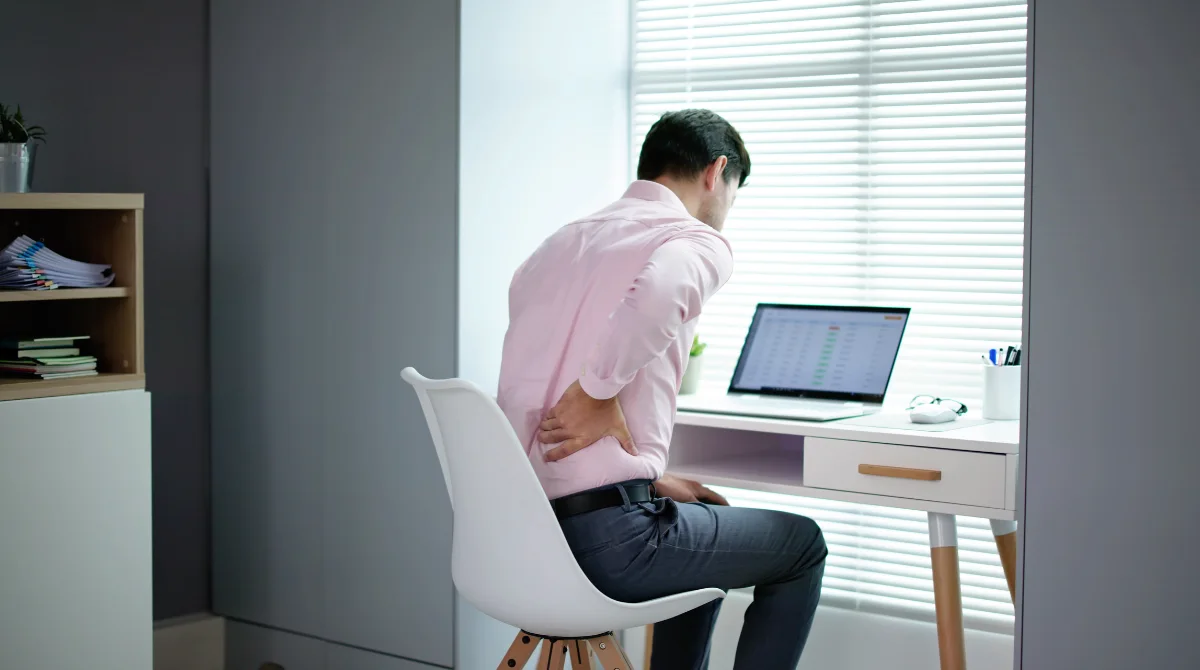
You wake up with pain after sleeping due to three primary factors: sleep surface limitations (your mattress no longer provides adequate support), sleep position biomechanics (certain positions strain joints and spine), and overnight physiological changes (fluid shifts and reduced circulation during 7-8 hours of immobility).
In a self-reported survey conducted by OnePoll, 10% of Americans wake up with aches and pains daily, and on average, people experience morning pain about 12 times per month. Back pain is the most common complaint, affecting 64% of morning pain sufferers.
In many cases, morning pain can be influenced by sleep environment and biomechanics. In a published study, participants reported 48% reduction in back pain within four weeks of switching to a properly supportive mattress. This isn't something you have to accept as "just getting older." However, any persistent or worsening symptoms should always be evaluated by a clinician.
What Happens to Your Body During Sleep
Three physiological processes cause morning stiffness:
- Prolonged immobility can contribute to stiffness in some people, especially in joints that are already sensitive.
- Spinal discs rehydrate and expand overnight. Horizontal rest allows discs to absorb fluid, temporarily increasing pressure on surrounding structures
- Reduced movement overnight may contribute to stiffness and discomfort for some individuals.
This explains why movement brings relief. As you get up and move, synovial fluid warms and thins, restoring joint lubrication. Increased blood flow clears accumulated inflammation. Gentle activity redistributes spinal disc pressure.
If stiffness is frequent, severe, lasts a long time after waking, or is accompanied by swelling, warmth, or systemic symptoms, consider medical evaluation.
Many people experience this frustrating cycle firsthand. As one user shared on r/flexibility:
"I've been doing 10-15 minutes of yoga as soon as I wake up. On my days off work, I'll do another 10-15 minutes of yoga at night. On work days, I try to move around and do a couple stretches every couple hours or so (I work at a desk for 12 hours). My back pain has been much better since I started incorporating this into my day."
Sleep Position and Morning Pain: What Research Shows
Position-Pain Correlation
Data from Nova Southeastern University study
Side sleeping with symmetrical positioning produces the fewest morning symptoms. Stomach sleeping can increase neck rotation and place some people in a more extended low-back posture, which may aggravate symptoms in susceptible individuals.
Why Position Advice Often Fails
Here's what most sleep guides miss: you might change positions even 11-36 times per night.
A videotape study found adults average 11 body position shifts nightly, with a range of 3-17 times. Accelerometry research on 664 sleepers found participants spent about 54% of sleep time on their side, 37% on their back, and 7% on their stomach—cycling through multiple positions regardless of how they fell asleep.
Self-reports consistently overestimate position consistency. You believe you maintain one position more than you actually do. This gap between perceived and actual behavior explains why "just sleep on your side" doesn't solve the problem—your body naturally repositions throughout the night to relieve pressure, and each shift changes your support requirements.
Real-world experience from the community confirms how challenging this can be. On r/backpain, one user explained:
"I'm not trying to be flippant, but the best position really is whatever feels the best. A lot of people deliberately avoid comfortable positions and force themselves into painful positions because someone convinced them it was 'wrong' to sleep a certain way. If you're having bad back pain, there may not be many positions or setups that are comfortable but at least try to find what hurts less than any others. Some people have to sleep on a recliner or couch for a while after an injury or during a bad flare-up because that's the only place that feels okay - if laying on the couch with your feet propped up on one of the arms feels best, then that's your answer. If putting 4 pillows under your chest and sleeping on your stomach at an upward angle gives you the most relief, that's the way to go."
Your Mattress: The Research on Support and Pain
Mattress Quality Directly Affects Morning Pain
A study published in PMC found that replacing mattresses averaging 9.5 years old produced:
- 55% improvement in sleep quality
- 48% reduction in back pain
- Improvements visible within the first week
- Continued improvement of 24.2% from week one to week four
Firmness matters significantly. Controlled research comparing mattress firmness found:
- Medium-firm mattresses (64.6 HA) provide optimal sleep outcomes
- Participants fell asleep in 7.71 minutes on medium vs. 12.42 minutes on soft
- Soft mattresses produced 29.17 sleep stage transitions per night vs. 21.75 for firm—indicating more fragmented sleep
The Better Sleep Council reports that 28% of Americans cite mattress quality, age, or firmness as a cause of sleep problems.
Signs Your Mattress May Be Causing Morning Pain
Check these indicators:
- ☐ Visible sagging or indentations where you sleep
- ☐ Pain that started without changes in activity or health status
- ☐ Pain that improves throughout the day after you get moving
- ☐ Mattress is more than 7-8 years old
- ☐ You sleep better in hotels or other beds
- ☐ Waking with stiffness in the same location repeatedly
If several of these apply, your mattress could be a contributing factor.
The Fundamental Limitation of Static Mattresses
Even when you select optimal firmness, traditional mattresses face an inherent constraint: they provide fixed support that cannot adapt to changes throughout the night.
Your support needs shift when you move from back to side—side sleeping concentrates more pressure on shoulders and hips. A firmness that works in one position creates pressure points in another. Since you shift positions 11+ times nightly, a static mattress is constantly mismatched to your actual position.
Sustained pressure in the same areas may contribute to discomfort for some sleepers, which can lead to repositioning during the night.
This frustration is common among mattress shoppers. As one user noted on r/BuyItForLife:
"My recommendation is avoid memory foam mattresses. I bought one while I was single and when I met my partner both her and I would always wake up sore from trying to avoid rolling into the divot left by years of me sleeping directly in the middle. No amount of rotating the mattress ever fixed it. She also had a memory foam mattress at her place and although hers sagged less it was still an issue. First thing we did when we moved in together was go mattress shopping. We ended up buying an old school pocket coil mattress, and got a new bedframe with strong straight slats (rather than the ikea style curved slats.) We probably spent a good 2-3 hours laying on mattresses before deciding on one we both liked. The best part is because it's an old school style it's built to last, and completely flippable which is hard to find these days. I always used to wake up with small little pains in my back and shoulders and it's all completely disappeared with this new mattress and frame."
The Sleep Quality-Pain Connection
Sleep Duration and Pain: A Counterintuitive Relationship
Research reveals a U-shaped relationship between sleep duration and next-day pain. A study published by NIH tracking daily sleep and pain reports found:
Both insufficient and excessive sleep worsen pain outcomes. The 6-9 hour range—where 78% of nights fell in the study—represents the optimal window.
Sleep Fragmentation: The Hidden Pain Driver
Waking repeatedly during the night impairs restoration even when total hours seem adequate.
According to research in the Journal of Sleep Research, healthy adults average 12.7 awakenings of 1 minute or more per night. A PubMed review found that fragmented sleep increases light sleep stages and impairs next-day alertness even when total sleep time remains unchanged.
The result: you can spend 8 hours in bed and still wake exhausted and pain-sensitive because you never accumulated enough restorative deep sleep.
The Bidirectional Pain-Sleep Cycle
Pain and poor sleep reinforce each other in a documented cycle:
- 67-88% of chronic pain patients have sleep complaints
- ≥50% of insomnia sufferers have chronic pain
- Each one-point increase in pain score raises odds of sleep issues by 6%
Breaking this cycle requires addressing both vectors. Improving sleep quality reduces pain sensitivity; reducing pain improves sleep quality. Single-vector approaches show limited efficacy because the untreated vector continues driving the cycle.
Partner Sleep Disturbance: The Overlooked Factor
How Partners Disrupt Each Other
According to the Better Sleep Council, 40% of American adults report their partner's tossing and turning as a cause of sleep problems.
A Sleepopolis survey found:
- 56% are woken by their partner two nights per week or more
- 61% of men (vs. 33% of women) are typically the disruptors
Each partner disturbance resets sleep cycles, reducing restorative deep sleep. The cumulative effect manifests as morning fatigue and increased pain sensitivity.
The Firmness Compromise Problem
When partners have different firmness preferences, conventional mattresses force a compromise that fails both people. The American Academy of Sleep Medicine reports that 31-35% of U.S. adults occasionally or consistently engage in "sleep divorce"—sleeping separately—to accommodate differing needs.
Solutions that address partner differences:
- Motion isolation: High-density foam and individually pocketed coils reduce movement transfer
- Dual-firmness designs: Each partner controls their own side independently
- Zone-specific controls: Different body areas receive different support levels
Active Sleep Technology: Beyond Static Support
Why the Category Matters
Active sleep surfaces represent a fundamentally different approach. Rather than providing fixed support, they sense pressure and adjust in real-time.
What static mattresses cannot do:
- Adapt support when you shift from back to side sleeping
- Proactively relieve pressure before it triggers discomfort
- Respond to changing muscle tension or inflammation throughout the night
- Provide different firmness for each partner without compromise
Clinical Evidence for Active Surfaces
Research on active sleep technology comes primarily from clinical settings:
- A Cochrane review found alternating pressure surfaces reduced pressure ulcer incidence to 7.4% compared to foam
- A randomized controlled trial found participants on active mattresses healed pressure injuries 11.71 days faster than those on reactive mattresses
- More participants on active mattresses reported improved pain levels
In clinical settings, alternating-pressure surfaces are used to reduce pressure-ulcer risk in higher-risk patients.
Consumer products may use related pressure-redistribution concepts, but evidence and outcomes differ by population and condition.
Bryte's Approach to Active Sleep
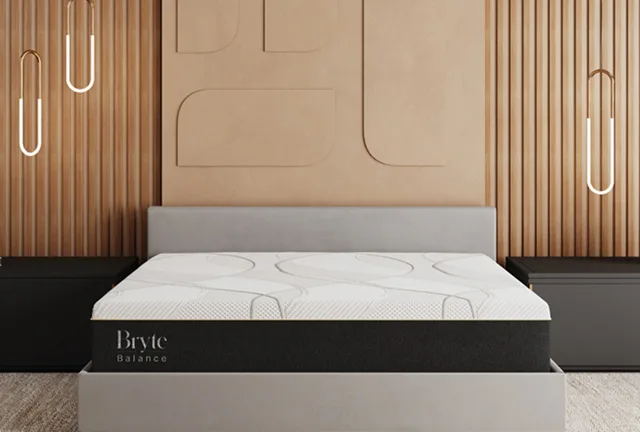
Bryte's technology addresses the specific limitations of static surfaces. The Bryte Adaptive Core™ contains up to 90 intelligent, pneumatic Bryte Balancers™ organized into 16 independent zones (8 per sleeper). These sensors detect even small pressure imbalances and make silent, automatic firmness adjustments in real-time.
Three models for different preferences:
All models feature Dual Comfort Design—each partner independently controls their side's firmness (0-100), runs their own relaxation tracks, and views their own sleep data. The system is powered by Restorative-AI™ and Bryte OS, delivering over-the-air updates that improve the sleep experience over time.
When Morning Pain Signals Something More Serious
Seek medical evaluation if you experience:
- Stiffness lasting more than 60 minutes after waking
- Joint swelling, warmth, or redness
- Pain that wakes you during the night
- Numbness or tingling in extremities
- Stiffness affecting multiple joints symmetrically
- Fatigue, fever, or unexplained weight loss accompanying pain
- Pain that worsens over time rather than improving
According to The Educated Patient, morning stiffness lasting longer than 30-60 minutes is a warning sign of inflammatory conditions like rheumatoid arthritis. The NHS notes that rheumatoid arthritis pain is often worse in the mornings and after periods of inactivity.
Most morning stiffness is benign and environmental. But persistent symptoms warrant professional evaluation.
Taking Action: A Practical Path Forward
Tonight: 3 Free Adjustments
- Pillow positioning — Side sleepers: pillow thick enough to keep head aligned with spine, plus pillow between knees for hip alignment. Back sleepers: thin pillow under knees to reduce lower back strain.
- Pre-sleep stretching — 5 minutes of gentle hip flexor stretches, hamstring stretches, and spinal twists before bed can reduce overnight tightness.
- Position experiment — If you wake consistently with shoulder pain and sleep primarily on one side, try alternating sides or experimenting with back sleeping.
This Week: Evaluate Your Mattress
- Check for visible sagging in your sleep area
- Lie on your back and assess: does your lower back feel unsupported (too soft) or do shoulders/hips feel excessive pressure (too firm)?
- Run through the checklist above—if three or more indicators apply, your mattress is likely contributing to pain
If Pain Persists: Consider Active Technology
When conventional solutions haven't provided relief, the category of active sleep technology addresses problems that static surfaces cannot solve. Bryte's portfolio offers options for different preferences, with trial periods that allow evaluation over weeks rather than showroom minutes.
Realistic timeline for improvement:
- Position and pillow adjustments: effects within days
- New mattress: improvements within the first week, continuing through week four
- Full evaluation period: 2-4 weeks to identify meaningful trends
Frequently Asked Questions
Why is my back stiff every morning but gets better after moving?
Answer: Overnight immobility causes synovial fluid to thicken (the "morning gel effect") and allows minor inflammation to accumulate in tissues. Movement restores normal fluid viscosity and circulation.
Key factors:
- 7-8 hours without movement triggers these changes
- Normal stiffness resolves within 30 minutes
- Stiffness lasting 60+ minutes warrants medical evaluation
How do I know if my mattress is causing my back pain?
Answer: Your mattress is likely contributing if pain started without activity or health changes, improves throughout the day, and you sleep better in other beds.
Check for:
- Visible sagging where you sleep
- Mattress age over 7-8 years
- Pain localized to pressure points (hips, shoulders)
- Improvement when sleeping elsewhere
What is the best sleeping position for back pain?
Answer: Side sleeping with symmetrical positioning produces the fewest morning symptoms, according to research from Nova Southeastern University.
Position hierarchy:
- Side (42% of sleepers): Lowest symptom rate, protective against cervical pain
- Back (~37% of sleep time): Generally neutral
- Stomach (7%): 47.5% report waking symptoms—avoid if possible
Is it normal to wake up stiff at 50?
Answer: Some morning stiffness is normal at any age, but regular pain that affects daily function isn't inevitable. CDC data shows sleep maintenance issues increase with age, but environmental factors—particularly mattress quality—often contribute more than aging itself.
How often should I replace my mattress?
Answer: Most mattresses degrade significantly by 7-8 years. Research showing 48% pain reduction involved replacing mattresses averaging 9.5 years old—suggesting many people wait too long.
Replace sooner if:
- Visible sagging appears
- Your body or sleep needs have changed (weight, injury, pregnancy)
- Pain patterns have developed without other explanation
Do smart mattresses actually help with back pain?
Answer: Clinical research supports active pressure redistribution for pain reduction. Hospital studies show active surfaces reduce pressure injuries and accelerate healing. Consumer smart beds apply the same principle—detecting and relieving pressure before it causes discomfort.
The key advantage over static mattresses: active technology adapts to position changes throughout the night rather than forcing you to find a single "right" firmness.
When should I see a doctor for morning stiffness?
Answer: Seek evaluation if stiffness lasts more than 60 minutes, affects multiple joints symmetrically, or accompanies swelling, warmth, fever, or unexplained weight loss.
Red flags requiring prompt attention:
- Pain that wakes you during sleep
- Numbness or tingling
- Progressive worsening over weeks
- Joint redness or warmth
Content Disclaimer
This article is for informational purposes only and is not medical advice. If symptoms are severe, persistent, worsening, or accompanied by swelling, warmth, numbness, fever, or unexplained weight loss, seek evaluation from a qualified healthcare professional.
The experiences described in this article are anecdotal and may not reflect typical outcomes.
Shop Bryte Beds
From the Park Hyatt New York to Rosewood Miramar Beach, thousands of guests have experienced Bryte in the world’s top hotels—now it’s your turn.