Best mattress for side sleepers with back pain: most people do best on a medium to medium-firm mattress that relieves pressure at the shoulders and hips while keeping the waist and lower back supported. In most cases, that means a zoned hybrid, supportive latex, or a foam hybrid.
Because firmness labels vary by brand, focus less on the label and more on the outcome: neutral spinal alignment, fewer pressure points, and less morning stiffness.
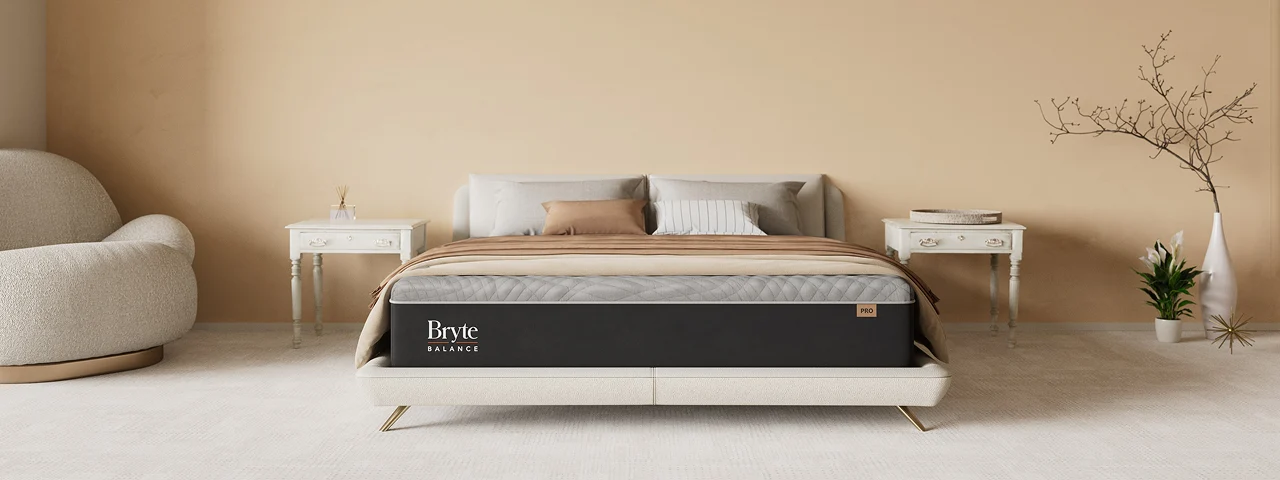
For sleepers who change positions often or couples with different firmness needs, a smart mattress like Bryte can also be a relevant option because it can adjust support & firmness down to the body zone over time, rather than staying fixed.
Best mattress for side sleepers with back pain
- Best overall: an adjustable smart mattress or medium to medium-firm zoned hybrid
- Best for pressure relief: foam hybrid, supportive memory foam, or adaptive smart mattress
- Best for hot sleepers: latex or breathable hybrid
- Best for over 230 lbs: firmer hybrid with stronger coil support
- Best for couples or frequent position changes: adaptive smart mattress
Note: Because firmness scales aren’t standardized, comfort and alignment should be assessed individually.
Why Side Sleepers Experience Back Pain Differently
Pressure Concentrates at Two Points
Side sleeping is commonly reported as the most frequent sleep position in surveys.
The biomechanics create a specific problem: body weight concentrates at shoulders and hips rather than distributing across the back.
Pressure mapping tests consistently show high-force concentration (orange/red zones) at these two contact points while the waist creates gaps with the mattress surface. In general sleep ergonomics guidance, NIH ergonomic research confirms that proper spinal alignment requires maintaining a straight line from head to pelvis, with ears level and spine horizontal.
What happens when mattress firmness is wrong:
- Too firm: Shoulders and hips cannot sink adequately, creating pressure points and gaps at the waist
- Too soft: Hips sink excessively, pulling the spine out of alignment
- Measured difference: Alignment studies report measurable differences in spinal posture on zoned designs compared with uniform soft or firm conditions, but optimal values aren’t standardized across individuals
Real users on Reddit echo these findings. As one community member shared on r/Home:
"Been a side sleeper for decades and yeah, back pain crept in hard once I hit my 30s. What nobody tells you is that "medium-firm" means NOTHING. One brand's medium is another brand's marshmallow. I'm about 220 lbs, and that changes the game too. My lighter friends love those soft foam beds but they wrecked my back. Gotta find something that actually holds up under weight. Coil support is underrated."
The Position-Change Problem
Most mattress advice ignores a critical variable: you don't stay in one position all night.
Research using accelerometers found that sleepers shift positions approximately 1.6 times per hour. A mattress optimized for side sleeping may fail by morning because your body moved through 10-12 positions, each with different support requirements, while the mattress remained static.
Research published in PMC found that people with spinal pain spend more time in provocative sleep postures. The mattress that felt ideal at 10 PM may contribute to morning stiffness at 6 AM because it couldn't adapt to position changes.
What Firmness Works for Your Body Type
Body weight significantly affects ideal firmness. The same mattress performs differently for different bodies—heavier individuals experience mattresses approximately one firmness point softer than rated.
Sources: NapLab, Mattress Clarity
This variability explains why "medium-firm" recommendations from clinical studies apply inconsistently. The 48% back pain reduction found in trials assumes the medium-firm rating matches the individual's body type—a condition that generic reviews rarely specify.
Clinical Evidence: Do Mattresses Actually Help Back Pain?
The Research Is Clear
Clinical trials provide specific evidence that mattress changes produce measurable results:
Key findings from peer-reviewed research:
- 48% back pain reduction after 28 days on medium-firm mattress (double-blind multicentric study)
- 55% sleep quality improvement in the same trial—benefits persisted 5-6 months
- 92% of adults 50+ with back pain reported symptom relief after new mattress purchase
- 35.1% pressure reduction on side torso with latex versus polyurethane foam mattresses
Sources: PMC, AARP survey of 300 adults 50+, PMC biomechanical study
The impact of finding the right mattress can be life-changing. A user on r/BuyItForLife shared their experience:
"i'm back to this post after getting my new mattress to share my recommendation, bc it's truly changed my life. i recently got the tempur pedic pro adapt in firm, & after 15 years battling incurable chronic pain, this is the first time i've EVER slept well again. i wasn't sure if a firm mattress would be right for me, but i got the medium tempur pedic adapt in december, & it was defective. so, i was able to replace it. the pro adapt is more expensive, but i've spent literally every single day since i've gotten it THANKING GOD that we were, miraculously, able to swing it!! it's not even broken in yet & it's still the best comfort of my whole life. the support is next-level. i have several different kinds of chronic pain, & ALL of them have been soothed somewhat because of this. like i said, my pain is incurable, but this is making it easier to manage. i have CRPS, central pain syndrome from a brain injury, rheumatoid arthritis, fibromyalgia, & chronic lower back problems, among other things. everyone is different, but these are the problems i've seen improve the most since i got the mattress. it's even helped me be able to work more & less painfully"
The Sleep-Pain Cycle
The relationship between sleep and pain operates bidirectionally—poor sleep worsens pain, which degrades sleep further.
Sleep problems are commonly reported among people with chronic pain.
Longitudinal research tracking 682 chronic pain patients found that 68.4% with improved sleep reported low pain at 12 months versus 33.1% with persistently poor sleep.
A systematic review found that 75% of individuals with chronic back pain experience poor sleep quality, compared to 25% without pain. This connection can make sleep comfort and setup feel more important—though a mattress is not a substitute for medical care.
Traditional Mattress Technologies: What Works and What Doesn't
Zoned Support Systems
Zoned mattresses provide different firmness levels across the sleep surface—typically 5-7 distinct zones. For side sleepers, the critical zones are:
- Softer shoulder zones for pressure relief and adequate sinkage
- Firmer lumbar zones to prevent midsection sagging
- Moderate hip zones balancing pressure relief with support
PMC research confirms that zoned softness produces better spinal alignment outcomes than uniform firmness.
Hybrid vs. Memory Foam vs. Latex
Biomechanical research found latex reduces peak pressure on side torso by 35.1% compared to polyurethane foam. Hybrids are most frequently recommended for back pain because they balance conforming pressure relief with structural support.
The Fundamental Limitation
Traditional mattresses share one constraint regardless of construction quality: they cannot adapt when you change positions.
A mattress with softer shoulder zones optimized for side sleeping may not support your back properly when you shift positions at 2 AM. Research from Oxford Academic found that adjustable bases allowing position shifts reduced perceived back pain by 28%—suggesting static mattresses may contribute to pain during natural position changes.
Active Pressure Resolution: How Smart Mattresses Address Static Limitations
Passive Cushioning vs. Active Adjustment
Smart mattresses represent a distinct technology category. Unlike traditional mattresses that passively cushion against pressure, smart mattresses actively detect imbalances and resolve them in real-time.
How the technology works:
- Sensors embedded in the sleep surface monitor pressure distribution continuously
- When the system detects concentrated pressure at shoulders or hips, it adjusts firmness in that specific zone
- When you change positions, the mattress modifies its support profile accordingly
This capability directly addresses the position-change problem. Rather than accepting a single firmness setting that may not suit all positions, the mattress provides dynamic support that changes as your body moves.
How Bryte's Technology Addresses Side Sleeper Back Pain
Bryte beds feature up to 90 intelligent pneumatic Balancers organized into 16 independent zones (8 per sleeper). This granularity enables precise pressure response that broader-zone systems cannot match.
The Adaptive Core technology:
- Sensors detect pressure imbalances in real-time
- AI processes data and makes silent, automatic firmness adjustments
- The system responds to position changes throughout the night
- Contour profiles provide softer shoulder zones and firmer lumbar support specifically optimized for side sleeping
Three models address different preferences:
PRO models include Individual Zone Control, allowing adjustment of specific areas like the lower back. Guided Comfort Tailoring uses AI to recommend firmness settings based on body attributes and sleep data.
Solving the Couples' Mattress Problem
The Scope of Partner Sleep Disturbance
Partner disturbance affects more couples than most realize:
- 35% of Americans occasionally or consistently sleep in a separate room from their partner
- 31% have engaged in "sleep divorce"
- 37% go to sleep at a different time than desired to accommodate a bed partner
- 32% report disturbances from partner's snoring or breathing
Source: 2024-2025 AASM survey, ResMed global sleep survey
When one partner needs specific firmness for side-sleeping back pain and the other has different requirements, traditional mattresses force compromise—often to a middle-ground firmness that's suboptimal for both.
This is a common frustration in the mattress community. As one user explained on r/Mattress:
"We also have a sleep number and hate it. Tried the Nest mattress because it can be ordered with 2 different sides. We ordered one side firm and one side plush and also hated it. We should have ordered it with medium across the whole bed. I agree with the sleep number offering no support once you make it soft enough to relieve pressure points."
Dual-Zone Technology Eliminates Compromise
Bryte's Dual Comfort Design allows each partner to independently control their side's firmness on a 0-100 scale. One partner could set their side to 55 for back pain support while the other chooses 45 for different preferences.
Additional couples-focused features:
- Independent zone adjustments on each side
- Separate relaxation tracks and sleep data per sleeper
- Silent Wake Assist uses gradual motion to wake one partner without an audible alarm
Trial Period Strategy: How to Know If It's Working
What to Track During Your Trial
Clinical research suggests measurable back pain relief can occur within 28 days. Most manufacturers offer 100-365 night trials. Use this time systematically:
Signs the mattress is working:
- Waking without stiffness in previously painful areas
- Spine maintains neutral position when lying on your side
- Reduced tossing and turning during the night
- Morning pain decreasing over time
Signs it's not working:
- Persistent morning stiffness that doesn't improve
- Numbness or tingling in extremities
- Pain that worsens over the trial period
Simple tracking method:
- Rate morning pain 1-10 daily
- Note wake-ups during the night
- Compare to your previous mattress baseline
When Premium Technology Makes Sense
Smart mattresses with AI-powered adjustment cost more than traditional options. The investment may be justified if:
- You've tried multiple traditional mattresses without lasting relief
- You change positions more frequently than the 1.6 per hour average
- You share the bed with a partner who has different firmness preferences
- Your back pain persists despite trying various firmness levels
The frustration of the trial-and-return cycle is real. As one user summed it up on r/Mattress:
"I have to tell you that I've learned nothing from these posts, except...mattress buying has become a complete pain in the butt, everyone's got an opinion that will probably mean nothing to me, DIY is a non starter and I'll just have to go back to buying, returning, trading out and rebuying."
For context: back pain costs Americans $100 billion annually in medical expenses and lost productivity. For individuals whose sleep-related pain significantly affects daily function, technology that addresses root causes—rather than static compromise—may provide value beyond comfort.
Frequently Asked Questions
What firmness is best for side sleepers with back pain?
Answer: Medium to medium-firm (5-6 on a 10-point scale) for most adults 130-230 lbs.
- Under 130 lbs: 3-4.5 (soft to medium-soft)
- 130-230 lbs: 5-7 (medium to medium-firm)
- Over 230 lbs: 6.5-8 (medium-firm to firm)
Can a mattress actually cause back pain?
Answer: Yes. Improper support creates spinal misalignment that compounds over time. Biomechanical studies show thoracolumbar angles of 12.66° on soft mattresses versus 4.10° on zoned mattresses—demonstrating measurable alignment differences.
How long should I try a new mattress before deciding?
Answer: Minimum 28-30 days. Clinical trials showed 48% pain reduction within 28 days on medium-firm mattresses. Your body needs time to adjust to a new sleep surface.
What's the difference between smart mattresses and regular mattresses for back pain?
Answer: Static versus dynamic support. Traditional mattresses provide fixed firmness optimized for one position. Smart mattresses detect pressure and adjust in real-time—addressing the 1.6 position changes per hour that static mattresses cannot accommodate.
How do I know if my mattress is causing my back pain?
Answer: If morning stiffness improves after you get moving and you notice you sleep better on other surfaces, your sleep setup may be a contributing factor worth evaluating.
Other indicators:
- Pain wasn't present before this mattress
- Discomfort has worsened as mattress aged
- You wake with numbness or tingling
- Pain improves when sleeping elsewhere
Do couples really need different firmness levels?
Answer: Often, yes. Body weight, sleep position, and pain conditions all affect ideal firmness. When one partner needs medium-firm for back pain support and the other prefers soft, dual-zone technology eliminates the compromise that leads 31% of couples toward "sleep divorce."
Is a smart mattress worth the higher cost?
Answer: It depends on your specific situation. Smart mattresses address limitations static mattresses cannot—particularly frequent position changes and couples' differing preferences. If you've failed with multiple traditional mattresses or share a bed with a partner who has different needs, active pressure adjustment may solve problems that better materials alone cannot.
Content Disclaimer
Please use this article for informational purposes rather than as a medical directive. We advise those with medical conditions or chronic physical discomfort to speak with a healthcare specialist. Additionally, the personal accounts included in this text are anecdotal and should not be viewed as typical for every user.
Shop Bryte Beds
From the Park Hyatt New York to Rosewood Miramar Beach, thousands of guests have experienced Bryte in the world’s top hotels—now it’s your turn.