The short answer: Memory foam isolates motion 3x better than springs (4.04 m/s² vs. 12.41 m/s²), but all passive materials degrade over time and can't adapt to different body weights. For couples who want motion isolation without sacrificing bounce or edge support, Active Pressure Relief technology—which combines real-time pressure sensing with real-time adjustments—breaks the traditional trade-off by managing motion dynamically rather than relying solely on material absorption.
Key strategies to reduce motion transfer:
- Choose memory foam or high-density foam materials that absorb kinetic energy
- Ensure your mattress is under 8 years old with no visible sagging
- Consider mattresses with independent zone control for couples
- For motion isolation without material compromises, explore Active Pressure Relief systems that adjust in real-time
82% of Couples Experience This Problem
If your partner's movements wake you at night, you're experiencing something the vast majority of couples face. According to a 2024 OnePoll survey, 82% of people in relationships admit their partner's sleeping habits consistently wake them up, with 25% specifically citing tossing and turning.
The numbers explain why this feels relentless: the average sleeper moves 40 to 50 times per night. Young adults average 3.6 position changes per hour—roughly 29 shifts across an eight-hour sleep period, according to research published in Sleep.
You're not being oversensitive. A 2020 study from Flinders University and Monash University using actigraphy data from 55 couples found that approximately 19% of all awakenings are "wake transmissions" from a partner's movement. On average, individuals receive about 6 wake transmissions per night.
This frustration is something couples across Reddit consistently share. As one user described their desperate search for solutions:
"I am an incredibly light sleeper and wake up to any movement. My boyfriend tosses and turns a ton in his sleep. I was getting the WORST sleep with him, which was having detrimental effects on our relationship. I would be cranky and snap at him all the next day, and often I'd only get a couple hours of sleep and wake up feeling sick. We didn't want separate bedrooms or even have a spare bedroom."
What Motion Transfer Does to Sleep Architecture
Motion transfer doesn't just cause momentary awakenings—it reshapes your sleep structure. Research published in Perceptual and Motor Skills found that motion transfer across a mattress causes a significant increase in Stage 1 sleep (light sleep) and a significant decrease in Stage 3 and Stage 4 sleep (deep, restorative sleep).
The cumulative effect: you're getting less of the deep sleep your body needs for physical recovery and cognitive function, even when you don't fully wake up.
The Relationship Ripple Effect
A meta-analysis of 62 studies covering 43,860 individuals found bidirectional ties between relationship quality and sleep quality (correlation of 0.34). Poor sleep strains relationships; relationship stress impairs sleep.
Cross-sectional analysis of 405 older couples found that spouses' sleep problems were independently linked to their partners' poor physical health, depressed mood, and relationship dissatisfaction.
Over 31% of U.S. adults have engaged in a "sleep divorce" according to the American Academy of Sleep Medicine's 2025 survey. But sleeping apart isn't the only solution when motion transfer is the underlying problem.
Material Performance: What Actually Isolates Motion
The Physics Behind Motion Isolation
When one partner moves, they generate kinetic energy that travels through the mattress. Materials that absorb and dissipate this energy prevent disturbance from reaching the other sleeper.
How different materials work:
- Foam compresses around the motion source and converts kinetic energy into heat through internal friction—limiting how far the disturbance travels
- Springs transfer energy through connected metal coils, allowing movement to propagate across the bed
- Air bladders rebound energy rather than absorb it, often creating more transfer than they prevent
Motion Transfer by Material Type
Source: NapLab accelerometer testing; PlushBeds analysis
According to Dweva's testing methodology, a motion isolation score of 7.5+ out of 10 is acceptable for most couples; 8.5+ is recommended for light sleepers or restless partners.
The Limitation All Passive Materials Share
Every passive material has the same fundamental constraint: it can't adapt to changing conditions.
Memory foam that provides excellent isolation when new will perform differently as it compresses over time. The Better Sleep Council reports that 77% of consumers replace mattresses due to deterioration—sagging, discomfort, squeakiness—all of which degrade motion isolation.
Passive materials also can't account for differences between partners. A 220-lb partner generates substantially more kinetic energy per movement than a 150-lb partner. Static materials can't dynamically adjust their absorption capacity based on who's moving.
This weight differential creates real challenges for couples, as this Reddit user discovered:
"My husband and I have been living together for almost a year now, I'm in college and a few months before we got married we moved into an apartment and realized we don't even own a mattress. Since then, for broke college kid reasons, we've bought two beds in a box from Sam's. The first one we settled on 'medium' and it KILLED my back, we went back and got the firm and it still (though admittedly less) gives me occasional back pain and I absolutely cannot sleep next to my husband. He's about 250 and I'm 150, and in our current mattress I need to sleep on the very edge with him as far away from me as possible to not sink into his orbit. He's even offered to sleep on the couch so I can get a decent night of sleep. Very sad and it makes me feel mean."
The Bounce and Edge Support Trade-Off Is Real
Why Traditional Materials Force a Compromise
If you've hesitated to choose memory foam despite its superior motion isolation, your concern is legitimate.
The same slow-recovery property that absorbs motion also reduces responsiveness. According to Fortune Recommends testing:
- Average mattress bounce: 9-12 inches in drop tests
- High bounce: 15+ inches
- Memory foam (motion-isolating): Under 5.99 inches
Consumer complaints documented in industry reviews cite foam's "limited bounce and response," describing it as feeling "slow" or "trapping."
Edge support presents a related challenge. According to Mattress Clarity testing, all-foam mattresses typically demonstrate the weakest edge support, while hybrids with reinforced coils outperform foam at the perimeter.
Breaking the Trade-Off: Active Pressure Relief
Hybrid mattresses attempt to split the difference—foam comfort layers over pocketed coil support. This provides better edge support than all-foam while retaining some isolation. But the trade-off persists at a less extreme level.
Active Pressure Relief technology takes a fundamentally different approach. Rather than relying on passive materials to absorb motion, Bryte's Active Pressure Relief responds to motion in real-time—managing pressure distribution dynamically rather than depending on fixed material properties that degrade over time.
This distinction matters: the bed actively addresses motion as it occurs rather than passively absorbing whatever energy the materials happen to capture.
Smart Beds: Why "Adjustable" Doesn't Mean "Better Isolation"
The Counterintuitive Finding About Air-Based Systems
Not all smart beds improve motion isolation. Some perform worse than average mattresses.
Air-based adjustable systems can measure significantly higher in motion transfer testing than average mattresses. Why? Air bladders rebound energy rather than absorb it. When one partner moves, compressed air displaces and returns energy back into the surface, creating transfer rather than preventing it.
This finding highlights a critical point: evaluate how a smart mattress achieves adjustability, not just whether it offers adjustable features.
The Three Characteristics That Determine Real Performance
1. Sound (Noise Level)
A mattress that makes noise when adjusting defeats its purpose. Any active adjustment mechanism must operate silently—otherwise, the adjustment itself becomes a sleep disturbance.
2. Resolution (Precision)
How precisely can the mattress sense and respond to pressure across its surface?
- Low resolution: A single air bladder or adjustment zone for each side of the bed can't differentiate between pressure at your shoulders versus your hips
- High resolution: Multiple independent zones can make targeted adjustments without affecting areas that don't need change
For couples, this matters because adjustments on one side shouldn't create noticeable changes on the other.
3. Response Time (Speed)
"Real-time adjustment" only works if it's genuinely real-time.
- A system that adjusts once per hour can't respond to the movement that wakes you at 2 AM
- A system that adjusts within seconds can actively manage motion as it occurs
What High-Resolution Active Pressure Relief Delivers
Bryte products use up to 90 intelligent, pneumatic Balancers organized into 16 independent zones (8 per sleeper). This high-resolution approach detects even small pressure imbalances and makes silent, automatic adjustments within seconds.
When a partner moves during the night, the system senses the pressure change and responds in the affected zones—without disturbing the other partner's side. This breaks the traditional trade-off because the bed actively manages pressure rather than relying solely on material absorption.
For couples with different body types or firmness preferences, Dual Comfort Design allows each partner to independently control their side's firmness on a 0-100 scale. The 8 independent zones per side ensure localized adjustments don't affect the other partner.
Topper vs. Replacement: A Decision Framework
When a Topper Can Solve Your Problem
Choose a topper IF all of these are true:
- ✓ Mattress is under 8 years old
- ✓ No visible sagging deeper than 1 inch
- ✓ No squeaking or noise when you move
- ✓ You need surface-level cushioning, not structural support
According to Tom's Guide, the average queen topper costs ~$319 (70% cheaper than a new mattress). Memory foam toppers score 4-5 out of 5 for motion isolation in testing.
Realistic topper lifespan: 1-3 years vs. 7-10 years for a mattress.
When Your Mattress Needs Replacement
Choose replacement IF any of these are true:
- ✗ Body impressions deeper than 1-1.5 inches
- ✗ Squeaking when either partner moves
- ✗ Mattress is over 8 years old
- ✗ You need independent firmness zones for different preferences
The Better Sleep Council reports the average replacement cycle has dropped to 8.3 years. Squeaking coils transfer vibration through any topper—you can't patch structural failure.
Cost comparison:
- $319 topper ÷ 2-year lifespan = ~$160/year
- $1,500 mattress ÷ 8-year lifespan = ~$188/year (with consistent performance)
Configuration Options for Different Preferences
Split king (two Twin XL mattresses): Eliminates motion transfer entirely at the cost of a center seam. Split frames hold 68.9% of the adjustable bed market due to demand for dual customization.
The split king solution comes up frequently in online discussions, with many couples finding it transformative:
"Separate beds. This is not me trying to be rude, but as someone who is a very light sleeper, no amount of special matteresses will keep me from waking up if someone tosses around next to me. If you still want to sleep next to each other, get at least separate matteresses to prevent the movement from transferring around the bed"
Dual-zone unified mattress: Each side adjusts independently while maintaining a connected surface. University of Hertfordshire research found 94% of couples who sleep while touching reported relationship happiness, compared to 68% of those who don't—suggesting unified surfaces may support relationship satisfaction better than complete separation.
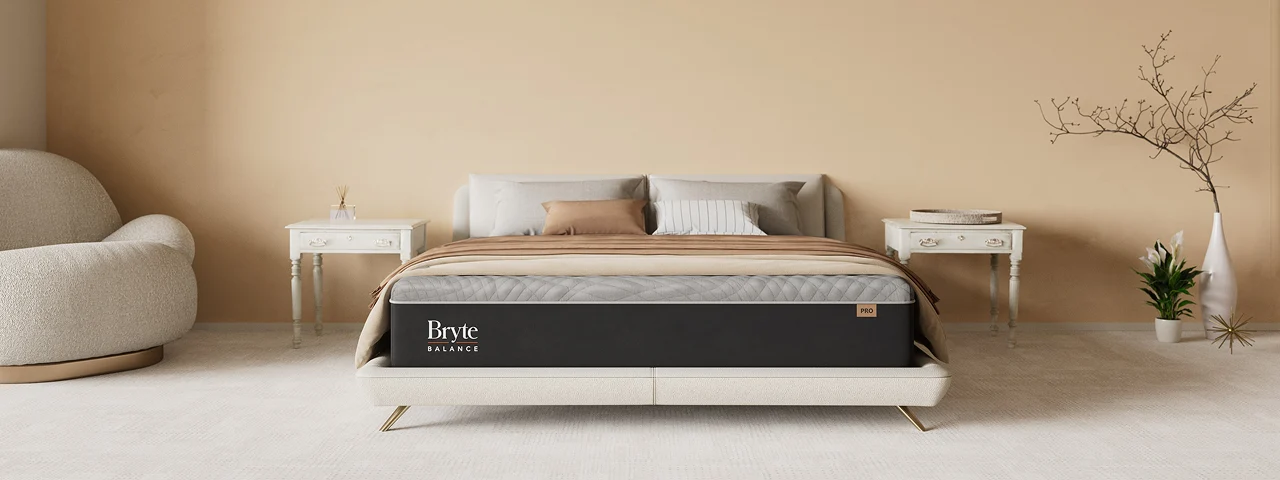
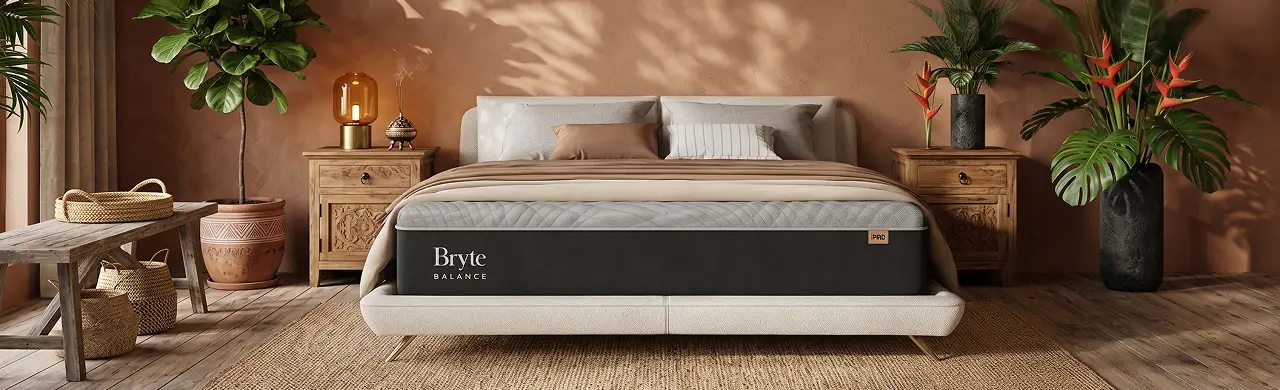
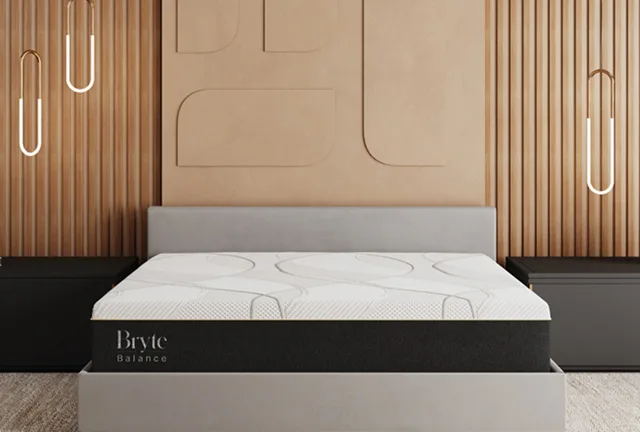
The Bryte Balance PRO offers Individual Zone Control with 8 zones per sleeper, allowing couples to adjust firmness in specific areas while maintaining a unified sleep surface.
Beyond the Mattress: Setup Factors That Matter
Foundation Impact
Your bed's support structure affects motion transfer independently of your mattress:
- Solid platform or closely spaced slats: Stable, uniform support that doesn't amplify motion
- Worn box spring: Can introduce its own motion transfer and noise
- Adjustable base: Evaluate motor noise—a loud motor activating during the night creates its own disturbance
One Reddit user discovered that even after trying multiple mattress solutions, the frame itself played a critical role:
"You should look at a couple different things if you want true isolation. First the mattress. Without knowing your budget, here are a few considerations. First, what is in the mattress. Full-foam models are typically best at this but to get a good one that will last, it'll cost you. If you want something with springs in it, make sure they are encased coils. That is they are individually wrapped vs an open coil matrix. You'll also want a thick layer of foam on top of the coils. Secondly is the size of mattress. The more distance you can put between yourselves, the better. King will make a big difference over queen. The ultimate would be a split king, which is two Twin XLs pushed next to each other. With the physical break between the two matts, it won't transfer anything at all. Lastly make sure you have a solid foundation under the mattress. If your bed frame or foundation is rickety, she'll feel you no matter what."
Waking Without Disturbing Your Partner
Motion disturbance extends to morning alarms. Traditional audio alarms wake both partners regardless of who needs to get up.
Alternatives:
- Vibration wrist alarms: Basic option; some people sleep through them
- Mattress-integrated silent wake: The Bryte Balance PRO Conform offers Silent Wake Assist—gradual motion through one side of the mattress surface without audible alarm, allowing the other partner to remain undisturbed
Frequently Asked Questions
What causes motion transfer in mattresses?
Answer: Motion transfer occurs when kinetic energy from one sleeper's movement travels through the mattress surface to the other side.
How materials handle it differently:
- Foam absorbs energy by converting it to heat through compression
- Springs transfer energy through connected metal structures
- Air bladders rebound energy, often increasing transfer
Is memory foam or innerspring better for couples?
Answer: Memory foam isolates motion approximately 3x better than springs (4.04 m/s² vs. 12.41 m/s² in accelerometer testing).
The trade-off: Memory foam has lower bounce and weaker edge support. Hybrids offer a middle ground; Active Pressure Relief technology addresses motion without the material compromises.
Can a mattress topper fix motion transfer problems?
Answer: A topper can help if your mattress is structurally sound (under 8 years old, no sagging over 1 inch, no squeaking).
When it won't work:
- Sagging defeats topper isolation—the topper conforms to the uneven surface
- Squeaky coils transfer vibration through any topper
- Structural failure requires replacement, not a patch
How often does partner movement actually wake you?
Answer: Research shows couples receive an average of 6 wake transmissions per night, accounting for ~19% of all awakenings.
Context: 82% of couples report their partner's movements wake them; 23% experience this several times per week.
Do smart beds reduce motion transfer?
Answer: Not automatically. Some air-based smart beds transfer significantly more motion than average mattresses because air bladders rebound energy rather than absorb it.
What to evaluate:
- Adjustment mechanism (air bladders vs. pneumatic zones)
- Resolution (single zone vs. multiple independent zones)
- Response time (hourly vs. within seconds)
What is Active Pressure Relief and how does it work?
Answer: Active Pressure Relief combines real-time pressure sensing with real-time adjustments—detecting pressure imbalances and responding within seconds rather than relying solely on passive material absorption.
Key distinction: Unlike manual adjustability, Active Pressure Relief responds automatically during sleep, addressing motion as it occurs without requiring user input.
How long do mattresses last before motion isolation degrades?
Answer: Average lifespan ranges from 7-10 years, with motion isolation degrading as materials compress.
By type:
- Innerspring: 6-8 years
- Memory foam: ~10 years
- Hybrids: 8-10 years
77% of consumers replace due to deterioration (sagging, squeakiness, discomfort)—all of which affect motion transfer.
Shop Bryte Beds
From the Park Hyatt New York to Rosewood Miramar Beach, thousands of guests have experienced Bryte in the world’s top hotels—now it’s your turn.