A genuine luxury mattress costs $1,800 to $4,600 for premium passive models and $4,000 to $6,500+ for AI-powered active sleep systems (queen size).
The right amount depends on whether your sleep problems stem from your mattress's materials or from deeper mechanisms like real-time pressure changes, partner incompatibility, or sleep onset anxiety. It’s worth noting that for the price of a high-end luxury passive mattress, you can often get an active smart sleep mattress.
This guide breaks down every tier, exposes the industry's markup economics, and gives you a framework to decide what's actually worth your money.
Full disclosure: This guide is published by Bryte. We engineered the Bryte smart mattress because we realized the traditional luxury mattress industry was charging premium prices for passive materials that failed to solve actual sleep disruptions. Here is our breakdown of the market economics, and why we believe Active Pressure Relief is the technology that justifies an ultra-premium investment.
The Real Stakes: This Is a Health Decision, Not a Furniture Purchase
60% of Americans don't get the recommended 7 to 9 hours of sleep nightly. Nearly 40% struggle to fall asleep three or more nights per week. Half of all respondents received an "F" for sleep satisfaction in the National Sleep Foundation's 2025 Sleep in America Poll of 1,372 adults.
These aren't people who refuse to go to bed. They're people whose sleep quality is poor even when they spend adequate time lying down.
The sleep crisis in five numbers:
- 60% of Americans don't get adequate sleep (National Sleep Foundation, 2025)
- 53% rate their sleep quality as fair or poor, even when logging 7+ hours (Mattress Firm/Harris Poll, 2,093 adults)
- 72% feel sleepy daily, impacting everyday activities (American Academy of Sleep Medicine, 2025)
- 26% are sleeping on mattresses over 7 years old, past their structural prime
- 40% struggle to fall asleep 3+ nights per week
What Poor Sleep Actually Costs You
The consequences go well beyond fatigue. A 2025 study published on PubMed found that trouble sleeping more than half the days is linked to a 63% higher risk of chronic pain and a 101% higher risk of high-impact chronic pain. The relationship is bidirectional. Pain disrupts sleep. Poor sleep amplifies pain sensitivity. This creates a cycle that no amount of passive cushioning can break on its own.
The economic costs are just as concrete:
- $280 to $411 billion lost annually from sleep deprivation in the U.S., roughly 2.28% of GDP (RAND Europe)
- $63.2 billion in annual productivity losses from insomnia alone (AASM)
- $3,156 per worker per year in lost productivity for insomnia sufferers
- 1.2 million working days lost annually
For a professional earning $250,000+, even a partial reduction in sleep disruption has measurable downstream effects on cognitive performance, decision-making, and physical recovery. Health and wellness is the only consumer spending category where Americans plan to increase spending in 2026, according to CivicScience data. That's not a coincidence. People are connecting the dots between sleep quality and everything else.
The 2026 Luxury Mattress Price Map: What Each Tier Actually Delivers
Four distinct tiers define the queen-size mattress market in 2026, based on testing data from NapLab (380+ mattresses tested) and industry pricing benchmarks.
For reference, the average mid-range hybrid runs about $1,524 and the average foam mattress about $1,088 (NapLab, 2026).
Each tier jump delivers diminishing returns on materials alone but increasing returns on sleep-problem-solving capability. Budget to mid-range gains better foam density and hybrid construction. Mid-range to luxury gains zoned support, organic materials, and 10+ year durability. Luxury to ultra-premium gains something fundamentally different: active intervention that addresses sleep mechanisms rather than just surface comfort.
The Markup Problem: How Mattress Pricing Actually Works
Here's what the mattress industry doesn't advertise. Mattresses are among the most heavily marked-up consumer products in retail.
The markup chain for a typical queen-size mattress:
- Manufacturing cost: $200 to $500
- Wholesale price: approximately $680
- Retail price: $1,000 to $1,600
- MSRP (before "sale"): $1,500 to $3,000
Source: IMARC Group manufacturing cost analysis and GoodBed pricing economics data.
The mattress industry historically marks up prices 100% to 200%, specifically to create room for perpetual "sale" pricing. A retailer might acquire a mid-range model for roughly $500, set the MSRP at $2,000, then offer a "50% off sale" at $1,000 while still maintaining a 50% gross margin. Some DTC brands have highlighted that traditional retail can add 300% to 400% markups from factory cost.
What this means for you: A $2,000 mattress on a 40% discount isn't a deal. It's likely the intended selling price. Two mattresses priced at $2,500 can have wildly different material quality depending on how efficiently the brand operates and how much it spends on advertising.
This markup structure creates a trust deficit that affects how buyers evaluate all price points, including legitimately premium ones. When a $2,000 mattress on "50% off" was always intended to sell at $1,000, buyers learn to distrust sticker prices entirely. That skepticism then transfers to the ultra-premium tier, where buyers assume a $5,000 mattress must contain $1,000 of materials. But the cost structure of an AI-powered active system with 90 pneumatic actuators, sensors, and continuously evolving software is fundamentally different from a foam-and-coil mattress.
How to Spot Overpriced Marketing Before You Buy
Six red flags that signal you're paying for branding, not quality:
- Perpetual "sale" pricing. If a mattress is always 40% to 50% off, the MSRP was never real. Use the sale price as the actual price.
- Vague materials language. Law tags listing "foam blend," "premium polyester," or "specialty fiber" without specifics are obscuring what's inside. Genuine luxury brands publish visible layer cross-sections.
- "Luxury" labels without certifications. Claims of "organic," "eco-friendly," or "natural" require verification via GOTS, GOLS, GREENGUARD Gold, OEKO-TEX, or CertiPUR-US. Partial-component certifications are not whole-mattress certifications.
- Short warranties at high prices. A $3,000 mattress with a 5-year warranty is a mismatch. Genuine luxury construction supports 10 to 25 year warranties, non-prorated in the early years.
- No independent reviews. Avoid brands whose only reviews exist on their own website. Cross-reference with independent testing sources and consumer review platforms.
- Vague "smart" or "AI" technology claims. As the Active Pressure Relief category grows, marketing language will proliferate. Ask: how many independent adjustment zones? What sensors are used? How fast does it respond? Vague claims are not the same as documented Active Pressure Relief systems with real-time sensing and real-time adjustment.
What Actually Justifies a Higher Price: Materials, Then Outcomes
The Materials Hierarchy and Where It Hits a Ceiling
Premium materials genuinely improve sleep quality and durability up to a point. At the luxury tier ($1,800 to $6,400), the legitimate material justifications include:
- Organic latex: Can last 15 to 25 years according to the Sleep Foundation. Naturally resilient, hypoallergenic, and responsive.
- High-density memory foam: Provides pressure relief and contouring for side sleepers and joint pain sufferers.
- Individually pocketed coils: Deliver targeted support and motion isolation for couples.
- Zoned construction: Different firmness levels for shoulders, lumbar, and hips.
- Premium covers: Wool, silk, or breathable knit materials for surface comfort.
Certifications like GOTS, GOLS, GREENGUARD Gold, CertiPUR-US, and OEKO-TEX verify that these material claims are real rather than marketing language.
But materials hit a natural value ceiling. Once you have high-density organic latex, zoned pocketed coils, and a premium cover, spending more on materials yields diminishing returns. A $3,500 passive mattress and a $5,000 passive mattress may use nearly identical materials. The extra cost often reflects brand positioning, retail overhead, or handcrafted construction techniques that don't measurably improve sleep outcomes.
This is the critical pivot point. If your sleep problems are caused by a worn-out or low-quality mattress, better materials will solve them. If your sleep problems persist despite a good mattress, materials alone won't help. The question shifts from "what is the mattress made of?" to "what does the mattress actually do?"
The Outcome Shift: Evaluating What the Mattress Does, Not Just What's Inside It
According to J.D. Power's 2024 U.S. Mattress Satisfaction Study (2,825 respondents), the top drivers of consumer satisfaction are comfort, value for price, and support. At the luxury tier, these are primarily material-driven. At the ultra-premium tier, they become mechanism-driven.
The distinction matters because passive and active luxury solve different categories of problems:
- Passive luxury solves "bad mattress" problems: poor materials, inadequate support, short lifespan.
- Active luxury solves "sleep mechanism" problems: pressure buildup during position changes, partner disturbance, sleep onset anxiety, the pain-sleep bidirectional cycle.
A buyer whose problem is a worn-out mattress needs passive luxury. A buyer whose problem persists despite a good mattress needs active luxury. Conflating the two leads to either overspending on materials that won't fix the issue or underspending on a passive mattress that repeats the same failure.
Passive vs. Active Luxury: The Most Important Distinction in 2026
Until recently, every mattress, regardless of price, was fundamentally passive. Built from materials that provide static support and cushion. Once you set a firmness level, that's what you get, whether you shift positions at 2 a.m., your partner moves, or your body's needs change throughout the night.
The luxury mattress market has now bifurcated into two distinct categories.
Passive Luxury ($1,800 to $6,400): High-quality materials, excellent construction, strong durability. Solves the "bad mattress" problem. Does not adapt to real-time body changes, partner movement, or the different phases of sleep.
Active Luxury ($4,000 to $7,500+): AI-driven systems that continuously detect pressure, movement, and comfort signals, then respond in real time without the sleeper waking. Solves not just the mattress problem, but the sleep problem itself.
The smart mattress segment is growing from $2.19 billion in 2025 to $2.5 billion in 2026, a 14.2% CAGR, fueled by AI and IoT health monitoring. The broader AI-powered sleep technologies market is valued at $13.6 billion in 2025 and projected to reach roughly $26.6 billion by 2030. AI health tool adoption doubled to 32% of U.S. consumers in 2025, according to Rock Health. This isn't a niche. It's a category crossing into the mainstream.
What "Active Pressure Relief" Actually Means
Active Pressure Relief is the defining capability of the active luxury category. It means real-time sensing of pressure points combined with real-time adjustments. Not manual firmness selection. Not adjustments on an hourly cycle. Continuous, automatic redistribution of pressure as the sleeper moves, shifts positions, or transitions between sleep stages.
This is not adjustable firmness (passive). This is firmness that adjusts itself, continuously, throughout the night, without any input from the sleeper. The "real-time" distinction is critical because it disqualifies products that only offer manual firmness adjustability but market themselves as "active."
The Three Criteria for Evaluating Any Active Pressure Relief Mattress
Not all "smart" or "active" mattresses deliver the same level of performance. Three characteristics separate genuine Active Pressure Relief from marketing claims:
1. Sound (Noise Level)
An Active Pressure Relief mattress must be silent. If the adjustment mechanism produces audible noise, it defeats the purpose by waking the sleeper it's trying to help. Any system using audible air pumps or mechanical actuators that create perceptible sound fails this test. Bryte's pneumatic Balancers operate silently, which is a core design requirement rather than an afterthought.
2. Resolution (Precision of Sensing and Adjustment)
Resolution refers to how precisely the system can detect and respond to pressure across the sleep surface. A system with a single air bladder per side of the bed, like those used by Sleep Number, has extremely low resolution. It treats your whole body as one unit. Bryte's active pressure relief, with 90 independent Balancers across 16 zones, can target your shoulder separately from your hip.
3. Response Time (Speed of Adjustment)
Some systems, such as Sleep Number, adjust only once per hour or periodically. Others adjust within seconds. When you roll from your back to your side at 3 a.m., the pressure distribution across your body changes instantly. A system that takes an hour to respond misses the moment entirely. Bryte adjusts within seconds.
These three criteria give you a framework to evaluate any brand claiming Active Pressure Relief technology. Ask the specific questions. If a brand can't answer them with numbers, the claims are marketing.
The Three Problems That Passive Mattresses Cannot Solve
Understanding where passive luxury fails clarifies what the ultra-premium tier is actually paying for.
1. Pain During Sleep
Even the finest memory foam or latex is static. When a side sleeper creates a pressure point on their shoulder or hip, a passive mattress can cushion it but cannot redistribute that pressure in real time. The sleeper's nervous system detects discomfort, triggers micro-arousals, and interrupts deep or REM sleep.
A 2025 PubMed study found that trouble sleeping is linked to a 63% higher chronic pain risk, and the relationship is bidirectional. Pain disrupts sleep. Poor sleep amplifies pain sensitivity. This cycle is precisely what Active Pressure Relief is designed to break. By detecting pressure buildup and redistributing it before it reaches the threshold that triggers a micro-arousal, the system intervenes where passive materials cannot.
2. The Partner Problem
35% of couples argue about mattress firmness. The Better Sleep Council found a roughly 50/50 split in firmness preferences across American adults. Half prefer firm or very firm. Half prefer soft or very soft. Every shared passive mattress is a guaranteed compromise.
The consequences go beyond discomfort:
- 31% of Americans practice "sleep divorce," sleeping in separate spaces (AASM, 2025)
- 39% among adults aged 35 to 44, the demographic most likely buying a luxury mattress
- 82% of people in relationships are woken by a partner's habits (OnePoll)
- 25% cite partner tossing and turning from firmness discomfort
Even split-firmness passive mattresses partially address this. But they still can't adapt to how each partner's needs change throughout a single night or prevent motion transfer during position changes.
3. The Sleep Onset Struggle
Falling asleep is not something materials can reliably accelerate. Anxiety, racing thoughts, and physiological arousal are barriers that foam and coils simply cannot address. Yet 40% of Americans struggle to fall asleep three or more nights per week (National Sleep Foundation, 2025). This is a mechanism problem, not a materials problem.
How Active Pressure Relief Technology Changes the Value Equation Above $4,000
This is where Bryte's Active Pressure Relief technology represents a genuinely different product category. Not merely more expensive foam. A system built to address the three problems passive mattresses cannot solve.
Active Pressure Relief for Pain Management.
The Bryte Balance uses 90 AI-powered Balancers across 16 independent zones (8 per sleeper) to silently and continuously monitor and adjust firmness. When pressure builds at any point, a hip, a shoulder, the lumbar spine, the system redistributes it within seconds, before it rises to the threshold that triggers a micro-arousal. This is high-resolution, near-silent, real-time Active Pressure Relief. It scores well on all three evaluation criteria: silent pneumatic operation, 90-point resolution across 16 zones, and response times measured in seconds rather than hours.
BryteWaves for Sleep Onset.
To address the sleep onset problem, Bryte integrates gentle, rhythmic physical motion within the mattress, synchronized with curated audio tracks including nature sounds, guided meditation, and breathing exercises. This multi-sensory approach physically lowers the physiological arousal state that keeps people awake. PRO models add a library of guided breathwork and focused intention programs via an AI-powered Sleep Concierge.
Dual Comfort Design for Couples.
Each side of the Bryte Balance is independently controlled on a 0 to 100 firmness scale, with independent relaxation tracks and individual sleep data through the Bryte app. The Silent Wake Assist feature uses gradual motion to wake one partner without an audible alarm, protecting the other's sleep. For couples where one partner prefers firm and the other soft (which statistically describes roughly half of all couples), this isn't a luxury. It's a functional necessity that eliminates the need for compromise or sleep divorce.
Comparing the Bryte Models
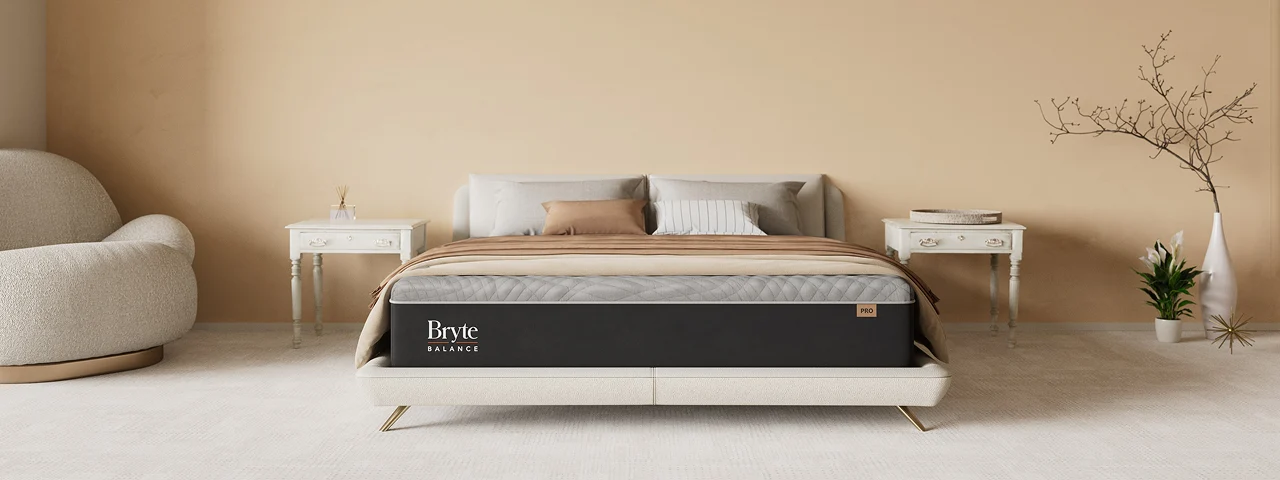
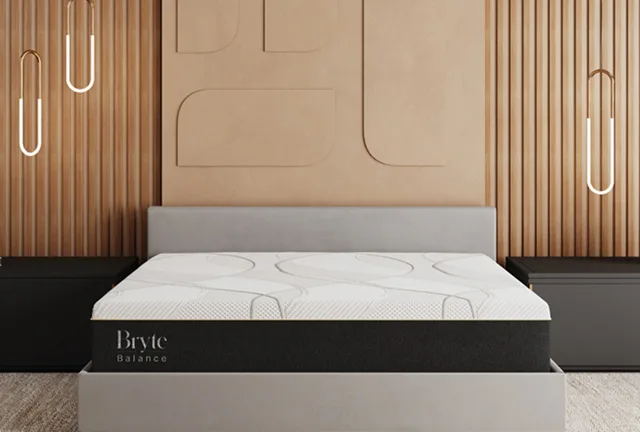
The Bryte Balance uses a breathable Tranquility support layer. For enhanced zone control, the Bryte Balance Pro features a 3-inch Serene premium comfort layer, while the Bryte Balance Pro Conform utilizes high-density gel-infused memory foam.
All three models run on Bryte OS, a continuously evolving software platform that delivers over-the-air updates. This means the mattress improves over time rather than degrading. That's a structural advantage no passive mattress can match.
The $1,700 difference between the Balance and the PRO models buys you Individual Zone Control (different firmness for your lower back versus your shoulders on your own side), the AI Sleep Concierge for guided personalization, and either a thicker premium comfort layer (PRO) or enhanced motion isolation via gel-infused memory foam (PRO Conform). For chronic pain sufferers or couples with significantly different sleep preferences, that $1,700 buys meaningful additional capability.
Bryte also offers a Premium Adjustable Base at $1,499 (queen) with head and foot articulation, under-bed lighting, Zero-G positioning, and One-Touch Flat. Better Sleep Council research found that 33% of buyers spending $2,500+ also purchased adjustable bases, rising to 44% for those spending $5,000+.
The True Cost of the "Mattress Merry-Go-Round"
The smartest way to evaluate mattress value isn't the sticker price. It is evaluating how long the mattress will actually meet your changing physical needs. Many buyers find themselves trapped in the "mattress merry go round", spending $1,500 on a mid-range bed, realizing it hurts their back two years later, spending $400 on premium toppers to fix it, and eventually throwing it out to buy a $3,000 passive luxury bed. Over a decade, you can easily spend $5,000 or more through trial, error, and material degradation.
This is where Active Pressure Relief technology has a structural financial advantage over passive luxury. Because Bryte products continuously adapt to your body and receive software updates over time, they are designed to be the last sleep system you need to buy. You are paying to break the cycle.
Trials, Warranties, and Buying Logistics
What to Expect at the Luxury Tier
Sleep trials and warranties are not just perks. They're trust signals that indicate how confident a manufacturer is in their product.
- 40.9% of tested mattresses carry 100/101-night sleep trials (NapLab, 290 mattresses analyzed)
- 22.3% offer 120-night trials
- 27.1% offer 365-night trials
- 95% of customers keep their mattress after the trial period
At the luxury tier, expect a minimum of 100 nights and a 10-year warranty. Bryte offers both across all three models. The 100-night trial is particularly important for Active Pressure Relief technology because the AI system needs time to learn your sleep patterns and optimize. You're not just testing comfort on night one. You're testing a system that improves over weeks.
Online vs. In-Store: The Data Says It Doesn't Matter
J.D. Power's 2024 U.S. Mattress Satisfaction Study scored both in-store and online mattress purchases at 867 out of 1,000. Identical satisfaction. For buyers hesitant about purchasing a $4,799+ mattress online, the data is clear: the trial period is your showroom. The 100-night window gives you far more evaluation time than any 15-minute store visit.
The Bottom Line: What You Should Spend Based on Your Situation
There's no single right number. But there is a clear framework.
- Spend $700 to $1,800 if your core issue is an old or structurally compromised mattress. A quality mid-range hybrid from a transparent brand will solve most "bad mattress" problems and last 7 to 10 years. This is the right tier if your sleep problems are clearly caused by the mattress itself.
- Spend $1,800 to $6,400 if you need premium materials, zoned support for back or joint pain, organic certification, or motion isolation. This tier delivers the best passive materials available and lasts 10 to 15 years. Choose this if your sleep issues stem from the mattress and you don't need active intervention.
- Spend $4,000 to $6,500+ if passive mattresses have failed you. If you have chronic pain that interrupts sleep, a partner with incompatible firmness needs, sleep onset anxiety, or a performance-focused lifestyle where sleep quality has measurable downstream consequences. At this level, you're not buying a better mattress. You're buying a sleep system with Active Pressure Relief that works to solve the mechanisms behind poor sleep in real time.
The Bryte Balance PRO at $6,499 represents the clearest example of what justified ultra-premium spending looks like in 2026: 90 AI-powered Balancers, 16 independent zones, real-time Active Pressure Relief, multi-sensory sleep onset assistance, Individual Zone Control, dual independent comfort, and AI-driven personalization through Bryte OS. That is not an expensive passive mattress. That is a different category of product.
Better Sleep Council research confirms this buyer profile: 75% of high-end mattress purchasers ($2,500+) are triggered by dissatisfaction with their current mattress, and 33% cite health or medical reasons. If that describes you, you're not an outlier. You're the typical luxury buyer following the typical path.
What is a night of genuinely restorative sleep worth to you? For most people who've spent years on mattresses that never quite worked, and who've watched productivity, mood, and physical health pay the price, the answer makes the investment clear.
Frequently Asked Questions
How much should you spend on a mattress in 2026?
$700 to $1,800 for a quality mid-range mattress, $1,800 to $6,400 for passive luxury with premium materials, and $4,000 to $6,500+ for active sleep systems with real-time pressure adjustment.
The right tier depends on your specific sleep problem:
- Old or uncomfortable mattress: $700 to $1,800
- Need premium materials and zoned support: $1,800 to $6,400
- Passive mattresses haven't solved your sleep issues: $4,000 to $6,500+
Is a $5,000 mattress worth it?
Yes, if your sleep problems go beyond what materials can solve. At the $5,000 level, you're entering the Active Pressure Relief tier where mattresses sense and respond to pressure in real time.
Insomnia costs $3,156 per year in lost productivity. If the mattress reduces sleep disruption even partially, the math works.
What is the difference between a luxury mattress and a smart mattress?
A luxury mattress uses premium materials for static support. A smart mattress with Active Pressure Relief uses AI-driven sensors and actuators to detect pressure and adjust firmness in real time, throughout the night, without waking the sleeper.
The key distinction: passive luxury solves "bad mattress" problems. Active Pressure Relief solves "sleep mechanism" problems like real-time pressure buildup, partner disturbance, and sleep onset difficulty.
How long do luxury mattresses last?
10 to 25 years depending on materials.
- Budget innerspring: 4 to 7 years
- Mid-range hybrid: 7 to 10 years
- Luxury hybrid: 10 to 15 years
- Natural latex: 15 to 25 years
- Active technology (Bryte): 10-year warranty with software that improves over time
Do I really need an Active Pressure Relief mattress, or is that a gimmick?
Not a gimmick, but not for everyone. Active Pressure Relief matters if you:
- Wake with pain despite a good mattress
- Share a bed with a partner who needs different firmness
- Struggle with sleep onset 3+ nights per week
- Have tried mid-range or luxury mattresses that didn't solve the problem
Shop Bryte Beds
From the Park Hyatt New York to Rosewood Miramar Beach, thousands of guests have experienced Bryte in the world’s top hotels—now it’s your turn.