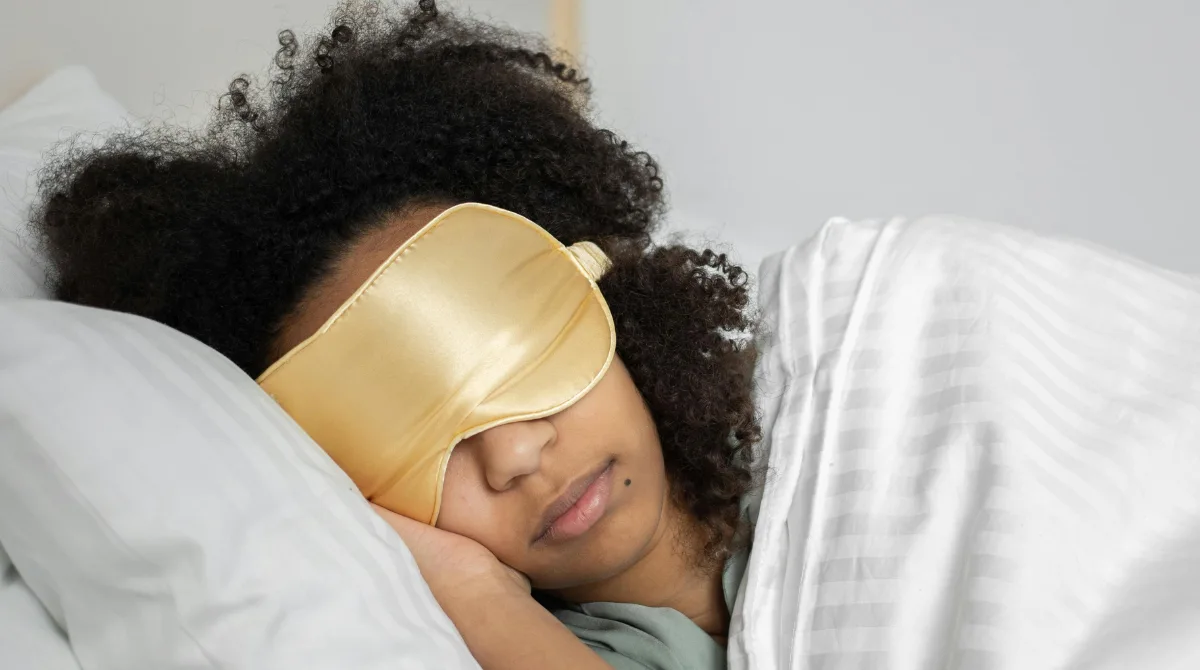
Looking for smart bedroom ideas that actually work?
Here is a quick checklist to get started:
- Smart lighting: Program bulbs to shift warm (2700-3000K) in the evening and cool (6500K) in the morning for circadian alignment.
- Smart thermostat: Set your bedroom to 60-67°F with an automated nightly cooldown.
- Blackout blinds: Automate window coverings to block all light during sleep hours.
- Air quality monitor: Keep CO2 below 900 ppm and humidity between 35-50% RH.
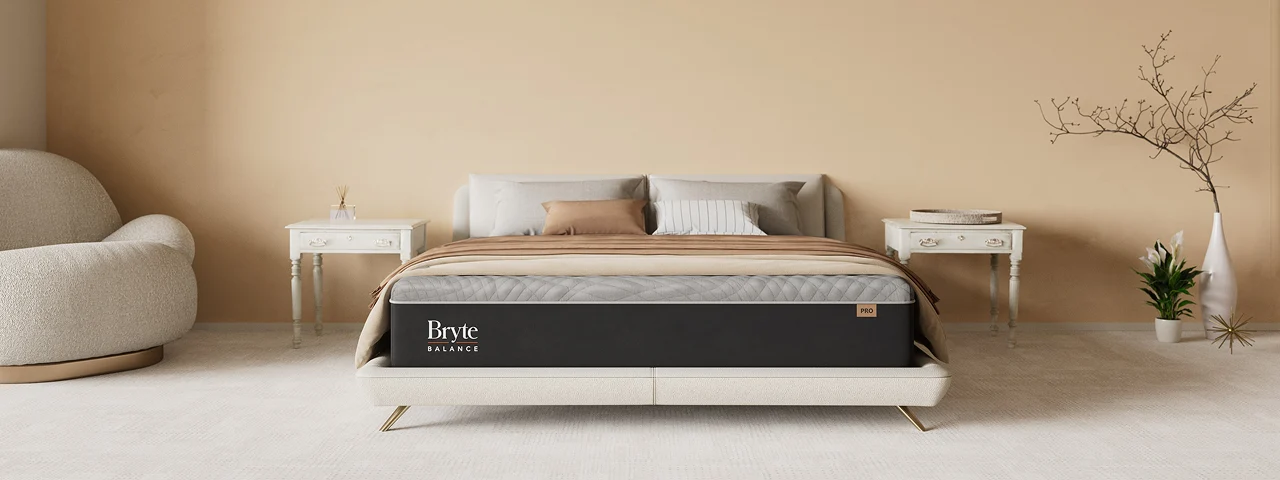
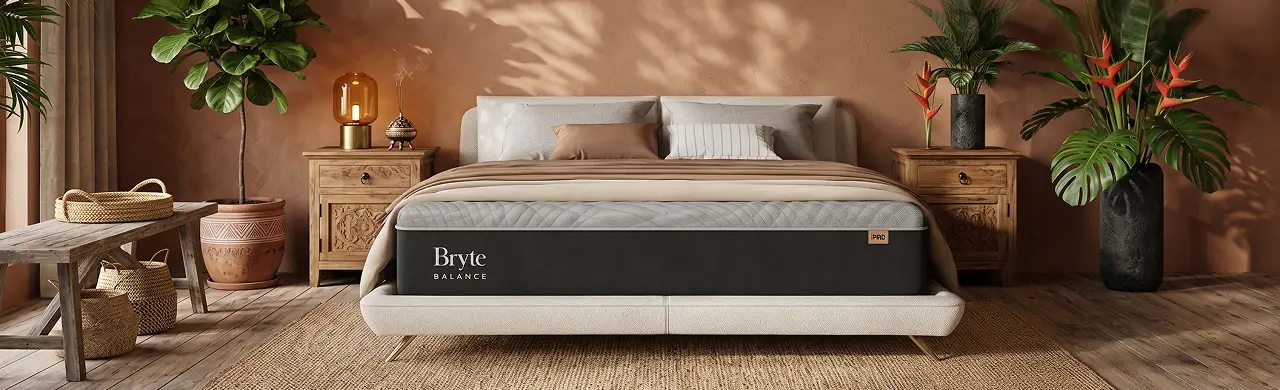
- Smart bed with Real-time Active Pressure Relief: The highest-impact upgrade, silently detecting and removing pressure points all night. Bryte's AI-powered smart beds use 90 Balancers across 16 zones to adjust firmness in real time.
Why does this matter right now?
According to the 2025 National Sleep Foundation poll, 60% of American adults don't get enough sleep. The personal cost is real: poor sleep quality is linked to $3,400 to $5,200 in additional annual healthcare spending per person. The National Sleep Foundation also found that 72% of people with good sleep health were "flourishing" in overall wellbeing, compared to just 46% of those with poor sleep. That's a 57% difference driven by one variable.
The smart bedroom ideas that follow dive deeper into each of these upgrades, ranked by measurable sleep impact. Every recommendation earns its place with science.
Smart Lighting and Climate: The Environmental Foundations
What Light Settings Improve Melatonin and Morning Energy?
Smart lighting is the most affordable high-impact upgrade you can make tonight. A Harvard Medical School study found that bedroom lights before bedtime suppressed melatonin production in 99% of participants, shortening the body's melatonin window by roughly 90 minutes. Blue light in the 460 to 490 nanometer range is the worst offender, suppressing melatonin for about twice as long as green light at equal intensity.
The fix is specific. Program your smart bulbs to shift to warm white (2700 to 3000 Kelvin) from 5:30 p.m. onward. In the morning, switch to cool white (6500 Kelvin) between 7 and 10 a.m. Harvard researchers found that people exposed to warm light in the evening fell asleep 19 minutes faster. A 2025 clinical study confirmed that patients in circadian-informed lighting environments gained 66 extra minutes of sleep per night. These aren't marginal differences.
One user on r/smarthome described how automating bedroom lighting transformed their sleep:
"Smart lighting, all the way. I had no real concept of the effect that light has on circadian rhythm until I started watching the Huberman Lab Podcast. I used to struggle with insomnia, but since automating my lighting, I'm sleeping better than at any time in my adult life. The house lights dim in the evening to allow my system to wind down and I programmed sunrise routines for all the bedroom bulbs in my house. Brightness slowly increases while the colors gradually change from red to orange to yellow to white. I set up a dashboard with variables that I enter for each room's wake time, so I can adjust it easily. After using it for a while, all my kids adjusted to waking up to the light and they're up naturally on time now. Don't even have to gripe at them and we don't use alarm clocks anymore."
Pair smart lighting with automated blackout blinds. A 2024 NIH study of nearly 47,765 women found that sleeping with a TV on raised insomnia symptoms by 50% and increased the odds of sleeping fewer than six hours by 1.46 times compared to complete darkness.
What Temperature Should a Smart Bedroom Be?
Your body drops its core temperature in the evening to trigger melatonin production. A room that's too warm disrupts that process directly. The optimal range is 60 to 67°F (15 to 19°C).
Research published in Sleep found that an 8°C increase in bedroom temperature reduces sleep efficiency by 10%. Even small shifts matter: for every 1°F increase in the 60 to 85°F range, total sleep time falls by nearly half a minute. Overheating is the dominant problem. According to the Sleep Foundation, 57% of U.S. adults report being too hot while sleeping, compared to only 37% who report being too cold.
This frustration surfaces regularly on r/insomnia, where one user shared their accidental discovery:
"I've been staying at a motel lately that has a good, reasonably quiet AC unit. I had been running an inadvertent experiment over the last weeks where I set my room AC temp abnormally low to 60 and had been getting the best sleep of my life. In fact, sleeping was pretty much all I had been doing. I only set it this low because it was balls hot when I walked in but just kind of liked it after. The other day, I turned off the cooler and my room warmed up to 74 and got the usual--get sort of tired, try to sleep, not have much motivation to sleep. It dawned on me to turn back on my AC. I dropped the temp to 64, and slept like a baby. I find it really odd that there's this galaxy of medications and sleep doctors but not one person has ever suggested this despite research suggesting the same."
A smart thermostat is a high-ROI starting point. Program a gradual cooldown beginning at 9 p.m. and a gentle warm-up before your alarm. ENERGY STAR-certified models save roughly 8% on heating and cooling bills.
The Smart Bed: Why Active Pressure Relief Is the Highest-Impact Upgrade
What Is Real;time Active Pressure Relief and Why Does It Matter?
Active Pressure Relief is a smart bed's ability to silently detect and remove pressure points in real time using sensors and automated firmness adjustments, without requiring the sleeper to wake up or make manual changes. This is fundamentally different from a standard adjustable mattress, where you choose a firmness setting and it stays fixed all night.
Three metrics separate a great smart bed from a mediocre one:
- Noise level. Adjustments must be silent. If the bed makes audible sounds while responding, it wakes you up and defeats the purpose.
- Resolution (precision). How precisely can the bed sense and respond across its surface? A system with 90 individual balancers across 16 independent zones offers far greater precision than a bed with a single air bladder per side.
- Response time. A bed that adjusts within seconds addresses discomfort before it wakes you. True real-time response is what separates Active Pressure Relief from simple manual firmness adjustability.
The clinical evidence for this category is strong. A 2024 study of 39 adults using a pressure-relieving mattress for eight weeks found Pittsburgh Sleep Quality Index scores improved from 7.49 to 4.92, a clinically meaningful change confirmed by Oura Ring biometric data. A systematic review found medium-firm mattresses reduced chronic low back pain by 48% and improved sleep quality by 55%.
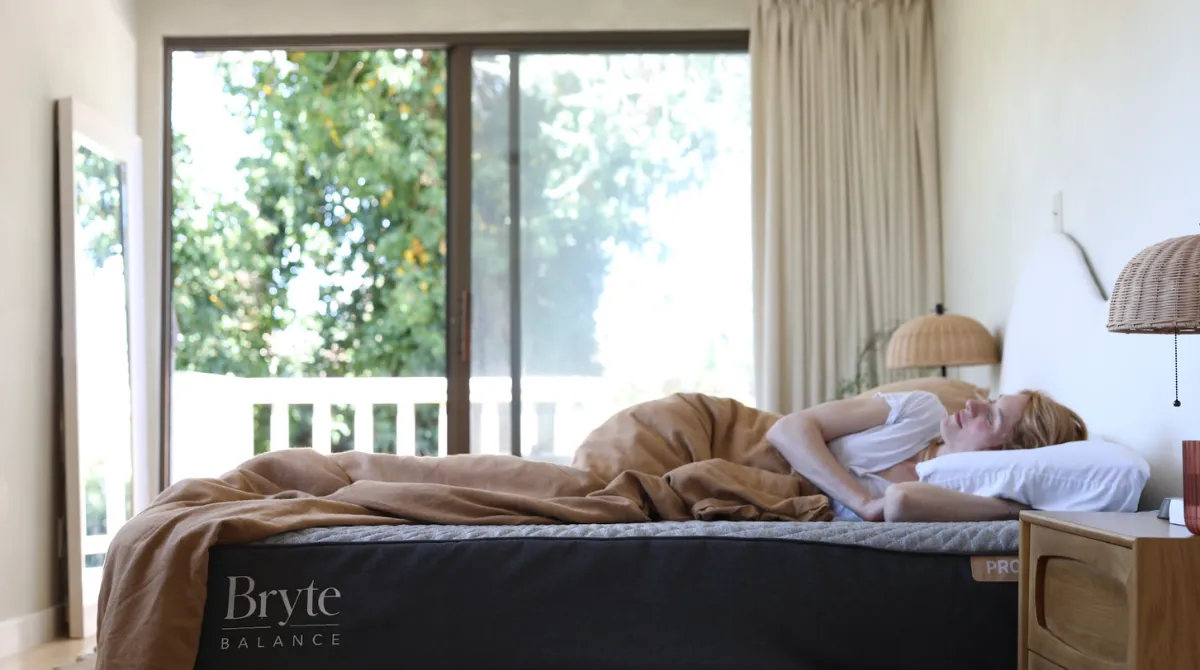
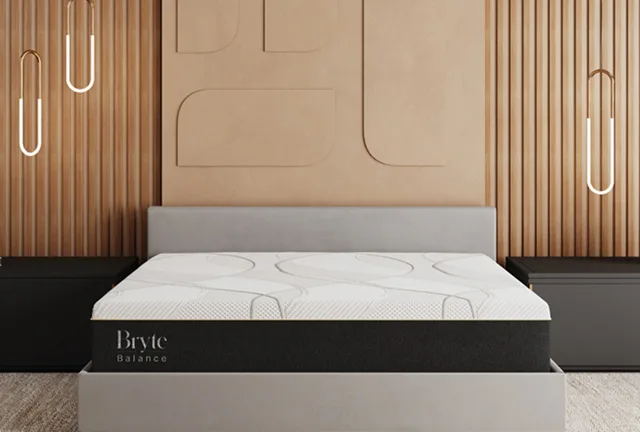
Bryte's Real-time Active Pressure Relief technology uses 90 AI-powered Balancers to silently detect and remove pressure points in real time across 16 zones (8 per sleeper), with firmness adjustable from 0 to 100 on each side. The Bryte Balance PRO adds Individual Zone Control for targeting specific areas like the lower back. Bryte also uses BryteWaves, a multi-sensory relaxation feature that syncs gentle rhythmic motion with curated audio to help you fall asleep. Because Bryte runs on Bryte OS, the bed receives over-the-air software updates and genuinely improves over time. Both models include a 100-night trial, so you can validate the results with your own sleep data before committing.
How Smart Bedroom Tech Solves the Couples Problem
Smart beds with dual-side independence let each partner control their own firmness (0 to 100), run separate relaxation programs, and use silent wake features. This eliminates the need for sleep compromise or separate bedrooms.
The problem is widespread. A 2026 ResMed Global Sleep Survey of 30,000 people found that 80% of co-sleepers experience disruptions: snoring (36%), a partner getting up at night (25%), and mismatched schedules (21%). A Sleep Foundation survey found 75% said their partner's snoring impacted their own sleep. Nearly 20% of couples opted for "sleep divorce" in 2025.
The struggle to find a mattress that works for both partners is one of the most common complaints on r/Mattress, where one user captured the frustration perfectly:
"Please help me from myself - I keep going down too many rabbit holes. Me and my partner are looking to upgrade our queen to a king mostly because the addition of a dog has made bed more cramped. I'm 5'3 160 lbs, he's 6'3 185 lbs. I prefer a softer bed, he prefers firm. Currently we have a Costco select Casper, I can't remember which one but I think it is medium firm. Neither of us are happy with it - too firm for me and too soft for him. I do get lower back pain and hip soreness from this bed and roll around a lot."
This is exactly the kind of mattress buying uncertainty that a smart bed solves. Instead of guessing which static firmness level might work for two different bodies, you get a bed that lets both partners dial in their own comfort independently and adjust over time.
Bryte's Dual Comfort Design addresses each of these causes directly. Each partner independently controls their side's firmness, runs their own BryteWaves relaxation tracks, and views their own sleep data through the Bryte app. The Silent Wake Assist feature uses gradual motion to wake one partner without an audible alarm. One bed, two fully personalized sleep experiences.
Sound, Air Quality, and Darkness: The Overlooked Variables
Does Pink Noise Actually Help You Sleep?
Many people assume sound machines are universally helpful. The data says otherwise. A 2026 University of Pennsylvania study found that pink noise at 50 dB actually reduced REM sleep by nearly 19 minutes per night, with participants reporting worse subjective sleep quality. Environmental noise at roughly 43 dB reduces deep sleep by about 23 minutes compared to quiet conditions. If you use a sound machine, keep the volume well below 40 dB. Silence may be better than you think.
Does Bedroom Air Quality Affect Sleep?
Yes, and more than most people realize. A 2024 study in Building and Environment found that every 100 ppm increase in bedroom CO2 correlates with a 0.29% drop in sleep quality. CO2 above 900 to 1,000 ppm triggers sympathetic nervous system activation, causing lighter sleep and more awakenings. A smart air quality monitor paired with automated ventilation keeps levels in check. Optimal humidity sits between 35% and 50% relative humidity.
Getting Started: A Phased Smart Bedroom Roadmap by Budget
Where to Start and How to Scale Without Wasting Money
Phase 1 delivers immediate results. Program warm-tone bulbs for evening and cool-tone for morning. Add automated blackout blinds. You'll feel the difference within days.
Phase 2 adds climate control. Program a nightly cooldown to 65°F and schedule your system with a single "goodnight" routine. The Matter protocol, now supported across Alexa, Google Home, Apple HomeKit, and Samsung SmartThings, solves the cross-brand compatibility problem.
Phase 3 is the centerpiece. Bryte products range from $4,799 for the Bryte Balance to $6,499 for the Balance PRO and PRO Conform. Over a 10-year warranty, a $4,799 bed works out to $1.31 per night. Compare that against $3,400 to $5,200 per year in healthcare costs linked to poor sleep. The 100-night trial removes the risk of committing before you know it works.
A note on privacy: A 2024 AHS survey found 57% of Americans have concerns about smart home data privacy. Look for devices that process data locally, offer clear data usage policies, and give you granular control over what is shared. Apple HomeKit processes most commands locally, making it a strong choice for bedroom voice control.
Frequently Asked Questions
What is the single most impactful smart bedroom upgrade?
The smart bed. It's the only device in continuous contact with your body all night. A bed with Active Pressure Relief silently detects and removes pressure points in real time, reducing pain-related awakenings and extending restorative sleep.
Can a smart bed help with back pain?
Yes. A systematic review found medium-firm mattresses reduced chronic low back pain by 48%. Bryte's 90 AI-powered Balancers across 16 zones go further by silently detecting and removing pressure points throughout the night, targeting discomfort before it causes you to wake up.
How is a smart bed different from an adjustable bed?
An adjustable bed changes head and foot elevation. A smart bed with Real-time Active Pressure Relief continuously senses your body and adjusts firmness in real time across multiple zones. The difference is passive positioning versus active, silent pressure management.
Do I need all my smart devices from the same brand?
No. The Matter protocol enables cross-platform compatibility across Alexa, Google Home, Apple HomeKit, and SmartThings. Look for Matter-compatible devices and they'll work together regardless of brand.
What is the best smart bed for couples?
Look for true dual-side independence: separate firmness control (0 to 100 per side), independent relaxation programs, individual sleep data, and a silent wake feature. Bryte's Dual Comfort Design offers all four.
Build Your Smart Bedroom One Layer at a Time
Start with the environmental basics: lighting, temperature, and darkness. Layer in air quality monitoring as your system grows. The highest-impact upgrade is the bed itself, where Active Pressure Relief technology like Bryte's silently detects and removes pressure points in real time to deliver measurably better sleep. Every addition should tie to a specific sleep outcome you can track. Whether you're starting with a pair of smart bulbs this weekend or ready to invest in a fully integrated sleep-performance system, the goal is the same: a bedroom that actively works for your health, every single night. The 100-night trial on Bryte products means the biggest investment in the system is also the one with the least risk.
Shop Bryte Beds
From the Park Hyatt New York to Rosewood Miramar Beach, thousands of guests have experienced Bryte in the world’s top hotels—now it’s your turn.