Are smart beds for couples really worth It?
Yes, if at least one common couple sleep problem applies to you:
- different firmness preferences,
- partner movement disturbance,
- sleep onset anxiety,
- or chronic pain.
These problems carry documented financial and relationship costs that far exceed the price of an adaptive smart bed. The clinical evidence and long-term math strongly favor the investment for couples dealing with these issues.
This breakdown covers the real numbers: what poor couple sleep already costs you, what peer-reviewed research says about adaptive sleep technology, how to evaluate smart beds using three metrics that actually matter, and which specific bed fits which couple profile.
Key Takeaways:
- Poor couple sleep can cost $18,000+/year in combined healthcare and productivity losses, making a $4,799 bed a financial hedge, not a luxury.
- 31% of Americans now sleep in separate beds; among millennials, 43%, signaling that traditional mattresses are structurally failing couples.
- Peer-reviewed studies show adaptive firmness reduces sleep onset time by 38%, back pain by 28%, and improves perceived sleep quality by 15%.
- Bryte's Active Pressure Relief uses 90 balancers across 16 zones to silently detect and remove pressure points in real time, independently for each partner.
- At $0.66 per partner, per night over 10 years with no subscription fees, the cost is less than a cup of coffee.
- A 100-night trial and 10-year warranty make the decision a reversible experiment, not a permanent commitment.
What Poor Couple Sleep Actually Costs: The Invisible $18,000/Year Problem
Most couples dramatically underestimate what bad sleep costs them. The expenses don't appear on a single bank statement. They're dispersed across doctor visits, sick days, reduced performance at work, and the quieter toll of relationship friction that compounds over months and years.
The Financial Drain
According to a RAND Corporation study cited by the American Academy of Sleep Medicine, insufficient sleep costs the U.S. approximately $207–$411 billion annually in lost productivity and healthcare expenses, roughly 1.23 million working days lost every year.
At the individual level:
- $7,000/year in additional medical expenses for individuals with sleep disorders, covering doctor visits, emergency care, and prescriptions (AASM / Slumber Theory).
- $1,967–$3,156/year in productivity losses per sleep-deprived worker.
- 14 missed work days + 30 underperformance days per year for workers with insomnia (AASM).
For a couple where both partners are consistently sleep-deprived, combined losses can reach $18,000+ per year.
That reframes the entire purchase decision. You're not asking "can we afford a $4,799 bed?" You're asking "can we afford to keep losing $18,000 a year to a problem we've normalized?"
The Relationship Damage
The costs aren't only financial. A 2024 meta-analysis from Peking University, published in Sleep Medicine Reviews, examined 62 studies across 43,860 individuals. The findings were unambiguous:
- Better relationship quality correlated with better sleep quality (r = 0.34).
- Higher relationship satisfaction linked to longer sleep duration (r = 0.39).
- Increased partner conflict associated with poorer sleep (r = 0.17).
An experimental study of 30 couples published in PMC ("Quarreling After a Sleepless Night," 2021) found that sleep-deprived couples showed significantly higher cortisol levels during conflict and less positive affect before and after disagreements.
The connection runs both directions. Research cited by the AASM found that for men, better sleep one night predicts more positive relationship ratings the next day. For women, negative partner interactions during the day worsen both partners' sleep that night.
Bad sleep makes you a worse partner. And being a worse partner makes both of you sleep worse.
That's not a metaphor. It's a documented feedback loop, and it compounds. A RAND/University of Utah study of 36 couples found that treating sleep problems directly was associated with higher relationship satisfaction and lower conflict. The implication: fixing sleep at the source can function as a relationship intervention.
The Sleep Divorce Epidemic: 31% of Americans Are Sleeping Apart
The clearest evidence that traditional mattresses are failing couples is the explosion of "sleep divorce."
According to the American Academy of Sleep Medicine's 2024 survey of 2,006 U.S. adults, 29% of Americans have opted to sleep in a separate bed to accommodate a partner. A 2025 AASM survey put the number at 31%, with adults aged 35–44 most likely at 39%. Among millennials: 43%.
What's driving couples apart:
- Conflicting sleep schedules (63% of millennials, 62% of Gen Z).
- Snoring (68% of Baby Boomers cite this).
- Firmness, temperature, and noise preference conflicts.
- 37% of respondents go to sleep at a different time than desired to accommodate a partner.
Sleeping apart does improve individual sleep metrics. People who sleep separately rate their quality 4–5 out of 5 at a 60% rate vs. 51% for co-sleepers, averaging ~37 more minutes of sleep per night (Fortune).
But the trade-off is real. Research published in the Journal of Health Psychology (2025) found that sleep divorce can erode emotional intimacy and sleep synchrony. A 2025 BMC Public Health study of 860 older couples found those in separate rooms reported worse psychological well-being.
The lived experience of couples on Reddit illustrates just how deeply firmness and movement incompatibility drives partners apart, even when they desperately want to stay together:
"My husband and I have been married for 41 years. I truly believe we would not have been able to stay married if we had not decided to sleep in separate rooms almost 20 years ago. The slightest noise wakes me, and I must have a soft, soft bed with a fan going (for white noise), plus the bedding has to be smooth, flat and tucked in. He is a very active and noisy sleeper (I swear the man levitates, flips in the air, then flops down when he turns over), needs a firm bed, cannot STAND having a fan on, and simply MUST have the bedding untucked so he can wrap it around his feet. Plus he stays up til all hours and I go to be at 9:00. Neither of us were sleeping well, and it was getting to be a really big problem, when the doctor diagnosed me with exhaustion and yelled at my husband that he had to make sure I got more sleep, at which point, he moved to a separate room. And that has saved not only our lives (sleeplessness is a huge health problem) but our marriage. You can certainly try two twin beds, as long as whatever is waking each of you up has to do with being in one big bed. If that doesn't work, try separate rooms. Saved us." (Source: r/RedditForGrownups)
Couples don't want to sleep apart. They want to sleep well together. That's the exact gap adaptive smart beds are designed to fill.
Why Traditional Mattresses Structurally Fail Couples
Before evaluating smart beds, it's worth understanding why a single-surface mattress creates an inherent compromise for two people.
Firmness Incompatibility
Approximately 51% of Americans prefer firm or very firm mattresses, while 49% prefer soft or very soft, a near-perfect split. Around 40% of couples explicitly report disagreeing on firmness. Side sleepers need softer surfaces for shoulder and hip pressure relief; back and stomach sleepers need firmer support for spinal alignment.
A single-firmness mattress forces at least one partner onto a suboptimal surface. Every night.
Movement and Snoring
75% of people sharing a bed with a snorer report sleep impacts, with 77% noting effects on well-being: 44% feeling sleepy the next day, 33% feeling irritable. Nearly 1 in 4 couples cite snoring as a reason for sleeping separately.
Motion transfer compounds the problem. One partner shifting, getting up, or moving restlessly throughout the night can fragment the other's sleep without either person fully realizing it.
One r/Mattress Reddit user's exhaustive two-year journey to solve motion transfer illustrates just how far couples will go, and how fundamentally limited traditional mattresses are for this problem:
"I am an incredibly light sleeper and wake up to any movement. My boyfriend tosses and turns a ton in his sleep. I was getting the WORST sleep with him, which was having detrimental effects on our relationship. I would be cranky and snap at him all the next day, and often I'd only get a couple hours of sleep and wake up feeling sick. We didn't want separate bedrooms or even have a spare bedroom."
A traditional mattress addresses none of these systematically. It's a static object applied to a dynamic, two-person problem.
What the Clinical Evidence Actually Shows
Couples who are skeptical of marketing claims deserve peer-reviewed data with methodology, effect sizes, and honest limitations, not brand-reported statistics.
Clinical Evidence Summary
What This Means for Couples
The 2025 Oxford Academic / SLEEP journal study on adaptive bases found users reported +15% improvement in perceived sleep quality, +18% improvement in feeling well-rested, and -28% reduction in back pain, all statistically significant at p<.001. The back pain subsample showed similar results: +16% sleep quality, +20% feeling rested, -27% pain reduction.
An important nuance: these studies showed strong subjective benefits but mixed objective polysomnography results. That's worth understanding honestly. The real-world perception of sleeping better has real-world consequences for mood, productivity, and relationship quality, even when raw sleep architecture data is mixed. For couples, subjective improvement is the outcome that matters. If both partners feel more rested, experience less pain, and argue less, the clinical mechanism is secondary to the lived experience.
The 2025 PMC firmness study found that medium-firm mattresses produced sleep latency of 7.71 minutes vs. 12.42 minutes on soft surfaces, 38% faster sleep onset. For couples where one partner needs softer and the other needs firmer, this research confirms that a single-firmness compromise is measurably costing at least one person sleep every night.
A 2022 University of Texas at Austin study demonstrated that active physical intervention reduced sleep onset time by approximately 58%, evidence that the body responds to physical relaxation cues, not just behavioral coaching.
A 2024 pilot RCT on AI sleep coaching found the intervention group gained +32.5 minutes of total sleep time (p=0.02) with 90% adherence over four weeks. This is promising but early-stage evidence. No change was observed in Pittsburgh Sleep Quality Index scores, suggesting AI-driven personalization may improve sleep quantity before it shifts standardized quality metrics.
The distinction between peer-reviewed studies and brand-reported statistics matters. Studies published in journals like SLEEP, PMC, and Sleep Medicine Reviews undergo peer review and disclose methodology. Brand-reported figures may reflect internal data that hasn't been independently validated. This breakdown prioritizes peer-reviewed sources.
How Adaptive Smart Bed Technology Works for Two People
Understanding smart bed features for couples requires understanding a fundamental distinction: the difference between a bed that lets you set a firmness number once and a bed that silently detects and removes pressure points in real time throughout the night.
We call this the Adaptive Response Hierarchy, three levels of mattress technology that determine how well a bed actually serves two people:
- Passive comfort (traditional mattresses): Fixed surface, no adaptation, one-size-fits-both.
- Manual adaptability (set-a-number systems): You choose a firmness setting before bed; the bed holds it.
- Active Pressure Relief (real-time adaptive systems): The bed silently senses and responds to pressure changes as they happen, without waking you.
Only the third level addresses the core couple problem: two bodies creating dynamic, changing pressure patterns throughout the night.
Active Pressure Relief: The Feature That Matters Most for Couples
Active Pressure Relief is real-time sensing and removal of pressure points with silent, real-time adjustments, automatically, while you sleep. Unlike a static mattress that simply cushions, or a manual system where you set a number before bed, Active Pressure Relief continuously monitors each partner's body and responds independently.
Bryte's 16-zone, 90-balancer architecture divides the mattress into 16 independent zones, 8 per sleeper. Within those zones, 90 AI-powered pneumatic balancers detect pressure imbalances and make silent, automatic adjustments to firmness. When a pressure point develops at the hip or shoulder, the system responds silently in real time to relieve it, reducing the chance that discomfort becomes a wake trigger.
Why this matters more for couples than solo sleepers:
- Two people bring different body types, sleep positions, and movement patterns to the same surface.
- One partner may shift from side sleeping to back sleeping at 2 a.m., creating entirely different pressure needs.
- A system that detects and responds to these changes silently and in real time means neither partner's sleep is disrupted by the other's body mechanics.
- Active Pressure Relief can help minimize pressure and wake events across all sleep positions, enable sleepers to stay in side sleeping positions longer without disruptions, and may help improve breathing for those affected by snoring.
The Three-Metric Framework: How to Evaluate Any Adaptive Smart Bed
Not all adaptive smart beds deliver the same quality of active response. Three metrics determine whether the technology works in practice or becomes a source of frustration:
1. Silence (Noise Level)
The entire purpose of an adaptive smart bed is to improve sleep without waking you. If the adjustment mechanism produces audible noise, it defeats its own purpose. Bryte's balancer system operates silently, which is why "silent" and "real-time" are inseparable when describing effective Active Pressure Relief.
2. Resolution (Precision)
How many independent adjustment points does the system use? A single air bladder per side can only inflate or deflate the entire surface uniformly. It cannot relieve pressure at your shoulder while maintaining support at your lower back. Bryte's 16-zone, 90-balancer system provides fundamentally different precision, addressing specific body regions independently. For couples where each partner's pressure points are in different locations, resolution is the difference between personalized comfort and a blunt compromise.
3. Response Time (Speed)
How quickly does the system react? A system that adjusts silently in real time within seconds can respond to a position change as it happens, preventing discomfort before it wakes you. A system that adjusts only once per hour, or only when manually triggered, leaves long gaps where pressure imbalances go unaddressed. For two bodies creating dynamic pressure patterns throughout the night, response time separates uninterrupted sleep from repeated micro-arousals.
These three metrics, silence, resolution, and response time, give you a practical framework for comparing any adaptive smart bed.
Couples-Specific Features: Independent Control, Relaxation, and Silent Wake
Several features are specifically designed for two people sharing a bed, not individual features repurposed for couples.
- Dual-Side Independent Control (0–100 per partner): Each partner sets their own firmness on a full 0–100 scale. This isn't a choice between two or three presets. It's complete personalization for each side. With ~40% of couples disagreeing on firmness and the national preference splitting nearly 50/50, independent control eliminates the need for compromise entirely.
- BryteWaves™ Multi-Sensory Relaxation: Available on all Bryte models, BryteWaves syncs gentle, rhythmic motion within the mattress with curated audio, such as nature sounds and guided meditation, to provide predictable vestibular input that signals safety during sleep onset. Each partner runs their own BryteWaves track independently. PRO models add a library of guided breathwork, meditation, and focused intention tracks. For couples where one partner falls asleep quickly and the other lies awake with sleep anxiety, BryteWaves lets the slower sleeper use active relaxation without affecting the partner who's already drifting off.
- Silent Wake Assist: Uses gradual motion localized to one side of the bed to wake one partner without an audible alarm. The other partner remains undisturbed. For couples with different schedules, this alone represents a meaningful improvement in sleep quality for the later-rising partner.
The Real Cost Breakdown: What You're Actually Paying
Bryte's Three Models: Complete Specifications and Pricing
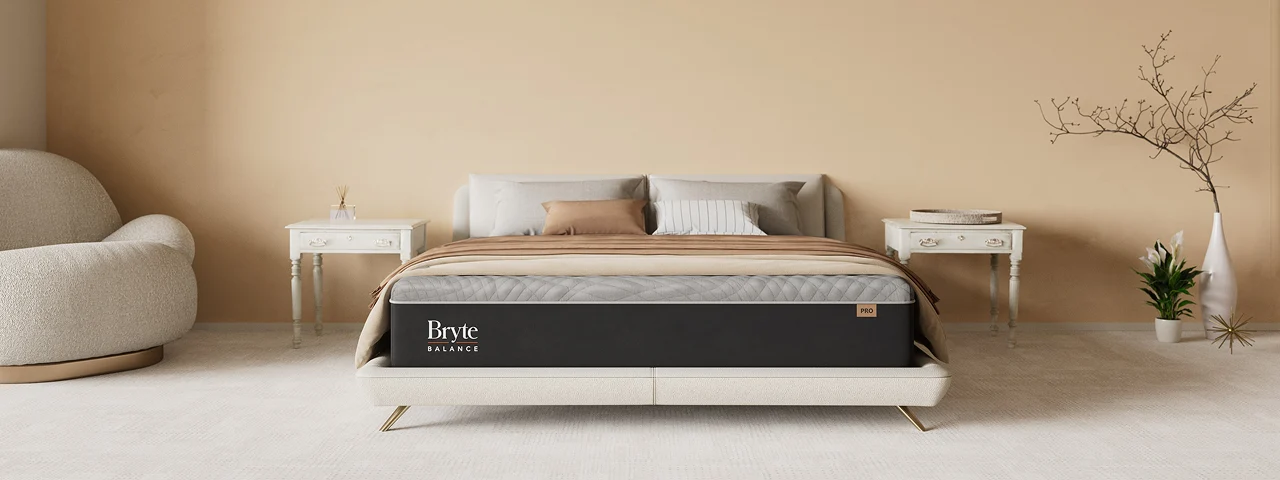
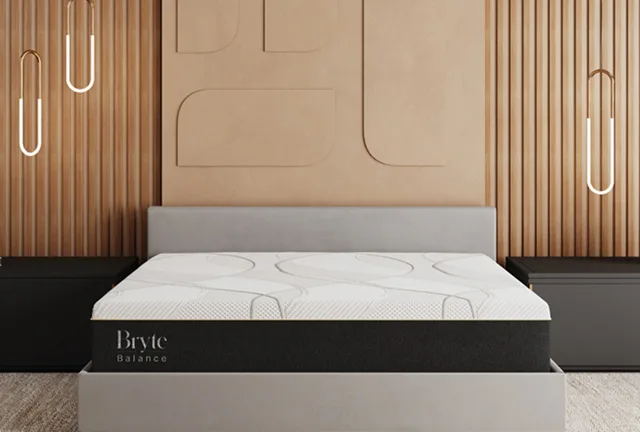
Bryte Balance - $4,799 (queen)
- Active Pressure Relief.
- 90 AI-powered Balancers in 16 independent zones.
- Medium-soft to medium-firm adjustability (0–100 per side).
- BryteWaves multi-sensory relaxation for sleep onset.
- 100-night trial.
- 10-year warranty.
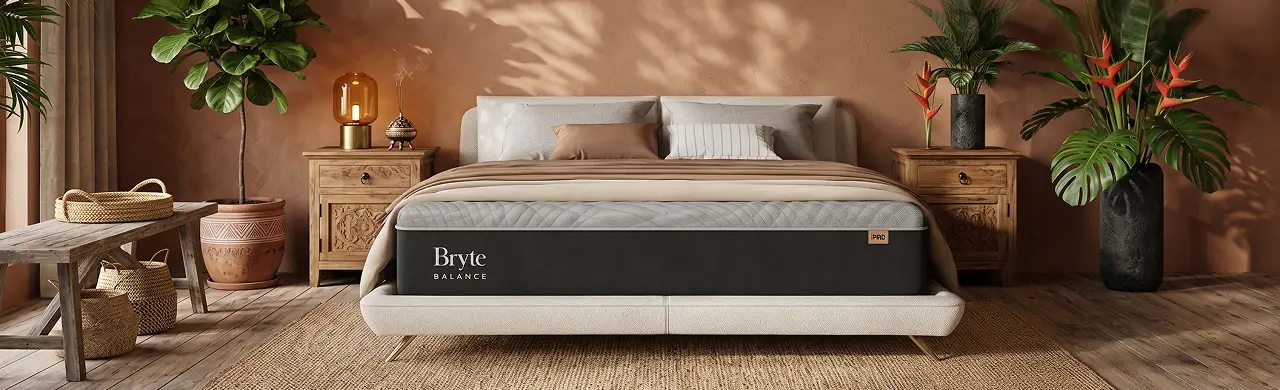
Bryte Balance PRO - $6,499 (queen)
- Active Pressure Relief.
- 90 AI-powered Balancers in 16 independent zones.
- Soft to medium firmness adjustability (0–100 per side).
- Individual Zone Control for targeting lower back.
- BryteWaves multi-sensory relaxation for sleep onset.
- AI-Powered personal Sleep Concierge.
- 3-inch premium comfort layer.
- 100-night trial.
- 10-year warranty.
Bryte Balance PRO Conform - $6,499 (queen)
- Active Pressure Relief.
- 90 AI-powered Balancers in 16 independent zones.
- Medium to firm firmness adjustability (0–100 per side).
- Individual Zone Control for targeting lower back.
- BryteWaves multi-sensory relaxation for sleep onset.
- AI-Powered personal Sleep Concierge.
- High-density gel-infused memory foam.
- Motion isolation plus adaptive technology.
- 100-night trial.
- 10-year warranty.
Cost Per Night: The Number That Changes the Conversation
$0.66 per partner, per night. That's less than a cup of coffee. And it covers Active Pressure Relief, BryteWaves relaxation, dual-side firmness control, and the full AI balancer system, with no recurring fees.
This is a meaningful distinction in the adaptive smart bed market. Some competitors charge ongoing subscription fees (~$17+/month) to access core features. Over 10 years, that adds $2,040+ to the total cost of ownership, on top of the hardware price, without which you lose significant functionality.
All Bryte core features work without a monthly payment. The PRO models' AI-Powered Sleep Concierge is included with the purchase, not gated behind a paywall.
The Cost of Doing Nothing
The documented annual cost of poor couple sleep, combining healthcare expenses and productivity losses, can reach $18,000+ per year when both partners are consistently sleep-deprived.
Against that figure, a one-time investment of $4,799–$6,499 with no recurring fees represents a fraction of a single year's cost of the problem it addresses.
Everyday cost comparisons:
- $0.66/partner/night (Bryte Balance) vs. ~$6 for a single coffee.
- $1.31/night for two people vs. ~$22.99/month for Netflix.
- $4,799 one-time vs. $18,000+/year in documented couple sleep costs.
Couples replacing traditional mattresses ($600–$1,500 per queen) every 7–10 years spend approximately $3,600–$6,000 over 30 years, with none of the active comfort, personalization, or sleep quality technology. Traditional mattresses also don't account for the ongoing costs of the problems they fail to solve.
A mattress that receives over-the-air software updates can improve its algorithms and add features over time. Traditional mattresses begin degrading the day you start sleeping on them. For couples evaluating long-term value, a platform that gets better over its lifespan rather than worse changes the cost-of-ownership calculation entirely.
Which Couples Benefit Most, and Who May Not Need a Smart Bed
An honest assessment requires acknowledging that not every couple will get the same return.
A Smart Bed Is Likely Worth It If:
✅ You disagree on mattress firmness. If one of you is a side sleeper who needs soft pressure relief and the other is a back sleeper who needs firm support, a traditional compromise mattress is making at least one of you sleep worse every night. Bryte's dual 0–100 independent control per side eliminates this.
✅ One partner's movement wakes the other. Motion transfer is a documented sleep fragmenter. Active Pressure Relief can help minimize wake events caused by movement. The Bryte Balance PRO Conform adds high-density gel-infused memory foam with motion isolation specifically for this scenario.
✅ One or both of you struggle to fall asleep. Sleep anxiety is one of the most common reasons people lie awake, and it's often contagious between partners. BryteWaves provides a physical pathway to relaxation. The UT Austin research shows physical interventions can reduce sleep onset time by ~58%.
✅ One or both of you experience chronic back, shoulder, or hip pain. The Oxford Academic study found adaptive technology was associated with a 28% reduction in back pain and 15% improvement in perceived sleep quality. Active Pressure Relief detects pressure imbalances and makes silent, automatic adjustments that can help reduce the chance discomfort becomes a wake trigger. (Bryte is not a medical device and does not diagnose, treat, or cure medical conditions, but the technology can help support better rest.)
✅ You have different wake-up schedules. Silent Wake Assist uses gradual motion on one side to wake one partner without disturbing the other. No alarm sound, no disruption.
✅ You've considered sleeping in separate beds. If you're contemplating separate rooms, an adaptive smart bed that eliminates the compatibility problem is a significantly better solution than sacrificing the intimacy and psychological benefits of co-sleeping.
Both partners can genuinely benefit, though the specific benefits may differ. One partner may gain the most from pressure relief for chronic pain; the other may benefit primarily from BryteWaves for sleep onset. The dual-side independence means each person's experience is personalized to their needs.
When a Smart Bed May Not Be the Right Investment
⚠️ Both partners share identical sleep preferences. If you genuinely have similar body types, similar positions, and neither is disturbed by the other's movement, the couple-specific features become less critical.
⚠️ Budget constraints are severe. A $4,799 purchase requires meaningful financial readiness. The 100-night trial mitigates risk, but it doesn't eliminate the upfront commitment.
⚠️ Sleep problems are primarily non-bed-related. If the root cause is clinical insomnia requiring cognitive behavioral therapy, untreated sleep apnea requiring a CPAP device, or environmental factors like noise or light, a smart bed alone may not address it. The bed can help support better rest as part of a broader approach, but it shouldn't be expected to solve the problem on its own.
Choosing the Right Bryte Model for Your Couple Profile
Bryte Balance - $4,799 (Queen)
The signature model and the most broadly suitable option for couples. It delivers the full Active Pressure Relief experience, 90 AI-powered Balancers in 16 independent zones, with medium-soft to medium-firm adjustability (0–100 per side), BryteWaves multi-sensory relaxation, a 100-night trial, and a 10-year warranty.
Best for: Couples who want the core benefits of Active Pressure Relief and dual-side independence without needing advanced zone targeting or AI coaching. If both partners fall within the medium-soft to medium-firm range and don't have specific lower back support needs, the Balance delivers the full adaptive experience at the best value. The Tranquility breathable support layer provides an ideal balance of bounce and support.
At $0.66 per partner per night, it's the highest-value entry point into Bryte's adaptive smart bed technology.
Bryte Balance PRO - $6,499 (Queen)
Adds deeper customization for couples where one or both partners have targeted support needs. Includes everything in the Balance plus Individual Zone Control for targeting the lower back, an AI-Powered personal Sleep Concierge, a 3-inch Serene premium comfort layer for air-cushioned pressure reduction, and a soft to medium firmness range (0–100 per side). BryteWaves on the PRO adds guided breathwork, meditation, and focused intention tracks. Cool-to-touch cover blend. 100-night trial and 10-year warranty.
Best for: Couples where one or both partners experience chronic lower back discomfort and need zone-specific firmness control, not just whole-side adjustment. The AI-Powered Sleep Concierge translates sleep data into actionable firmness recommendations tailored to each partner's body and sleep behaviors, removing the guesswork. The softer firmness range makes this particularly well-suited for side sleepers or couples where at least one partner prefers a plush feel.
Bryte Balance PRO Conform - $6,499 (Queen)
Designed specifically for couples where motion transfer is the primary complaint alongside the need for adaptive pressure relief. Includes Active Pressure Relief with 90 AI-powered Balancers in 16 independent zones, medium to firm adjustability (0–100 per side), Individual Zone Control for targeting lower back, BryteWaves, AI-Powered personal Sleep Concierge, high-density gel-infused memory foam, motion isolation plus adaptive technology, 100-night trial, and 10-year warranty.
Best for: The couple where one partner is a restless sleeper and the other is a light sleeper. The high-density gel-infused memory foam provides contouring and motion isolation that prevents one partner's movements from transferring across the surface. Combined with Active Pressure Relief, the PRO Conform offers something no passive memory foam mattress can: motion isolation that also actively adapts to pressure changes throughout the night. The medium to firm range suits couples where at least one partner prefers a firmer, more supportive feel.
Durability and Long-Term Confidence
Why Architecture Determines Reliability
Not all adaptive smart bed technologies age the same way. The common failure modes in the market are architecture-specific:
- Water-based systems: Leaks, tube degradation, foam sagging within 1–4 years; maintenance required every 2–3 months.
- Single-bladder air systems: Air chamber deflation, "trench effect" sagging in the middle, heat retention; ranked in the bottom 20% for overall reliability in independent testing.
- Foam degradation: Affects any mattress with foam components over time.
Bryte's mechanical balancer architecture avoids the primary failure modes of both water-based and air-based systems. The 90 pneumatic balancers are mechanical components, with no water circulation and no single large air chambers. This eliminates the risk of water leaks entirely and distributes the adaptive function across 90 independent points rather than concentrating it in one or two chambers where a single failure affects the entire surface.
Traditional mattresses last 7–10 years on average (innerspring 5–7; latex 8–12), according to the Sleep Foundation. Bryte's 10-year warranty is designed to match or exceed that lifespan, and over-the-air software updates mean the bed's intelligence can improve over time, a characteristic no traditional mattress offers.
The 100-Night Trial: A Reversible Experiment for Two People
The most legitimate concern with a premium mattress purchase is spending thousands and discovering it doesn't work for one partner. Bryte's 100-night trial directly addresses this.
Both partners have over three months to evaluate the bed across different conditions, varying stress levels, seasonal changes, different activity levels, before the commitment is final.
What to focus on during the trial:
- Are both partners waking feeling more rested?
- Have nighttime disruptions from movement or discomfort decreased?
- Have firmness disagreements been resolved through independent control?
- Has sleep onset improved for the partner who typically struggles to fall asleep?
- Is chronic pain reduced in the morning?
On setup and maintenance: Bryte's system doesn't require the water refilling, filter changes, or tube maintenance associated with water-based systems. The bed is controlled through the Bryte app, which provides daily sleep insights and management of the Dual Comfort Design. Over-the-air updates are delivered automatically.
The Bottom Line
If you're a couple where at least one documented pain point applies, whether that is different firmness needs, movement disturbance, sleep onset anxiety, chronic pain, or schedule conflicts, an adaptive smart bed isn't a luxury. It's a targeted solution to a measurable problem that's already costing you in healthcare expenses, lost productivity, and relationship quality.
The peer-reviewed research is consistent: poor couple sleep harms health, productivity, and relationship satisfaction in ways that carry real financial and emotional costs. The RAND Corporation quantifies those costs in the hundreds of billions nationally. At the individual couple level, they can reach $18,000+ per year.
At $0.66 per partner, per night over a 10-year warranty period, with no recurring subscription fees, the Bryte Balance isn't being compared against a traditional mattress. It's being compared against the accumulated cost of the problem it solves.
The 100-night trial makes this a reversible experiment. The 10-year warranty protects the long-term investment. And the over-the-air software updates mean the bed you buy today can improve over time.
As one r/sleep Reddit user put it after years of struggling with a partner's different sleep needs, the emotional weight of this decision goes far beyond mattress specs:
"This convo bright my wife to tears over months of gentle persistence. The symbolism was too tough for her to swallow. Eventually, we got a split king - now she loves it. For anyone considering the switch, it is absolutely, undeniably better."
Explore the full Bryte adaptive smart bed lineup to find the model that matches your couple profile.
Frequently Asked Questions
Are smart beds worth it for couples?
Yes, for couples experiencing at least one common sleep incompatibility. Different firmness preferences, partner movement disturbance, sleep onset difficulty, or chronic pain each carry documented costs, up to $18,000+/year combined, that far exceed the per-night cost of an adaptive smart bed ($0.66/partner/night for the Bryte Balance).
Strongest fit indicators:
- You disagree on mattress firmness.
- One partner's movement wakes the other.
- One or both of you struggle to fall asleep.
- You've considered sleeping in separate beds.
How much does a smart bed cost per night for two people?
The Bryte Balance costs ~$1.31/night for two people, about $0.66 per partner, per night when amortized over the 10-year warranty period. The Bryte Balance PRO and PRO Conform cost $1.78/night ($0.89/partner/night). No subscription fees are required for core features.
Do smart beds require a monthly subscription?
Bryte does not charge subscription fees for core features. Active Pressure Relief, BryteWaves relaxation, dual-side firmness control, and the AI balancer system all work without monthly payments. The PRO models' AI-Powered Sleep Concierge is included with purchase. Some competitors charge ~$17+/month, adding $2,040+ over 10 years.
Can each partner set different firmness on a smart bed?
Yes. Bryte's Dual Comfort Design allows each partner to independently control their side's firmness on a 0–100 scale. Each partner can also run their own BryteWaves relaxation tracks and view their own sleep data. PRO models add Individual Zone Control for targeting specific areas like the lower back.
Does a smart bed help with snoring and partner movement?
Active Pressure Relief can help with both, though Bryte is not a medical device. The technology detects pressure imbalances and makes silent, real-time adjustments that may help improve breathing positioning for snoring and minimize wake events from partner movement. The PRO Conform model adds dedicated motion isolation through high-density gel-infused memory foam.
How long do smart beds last?
Bryte smart beds carry a 10-year warranty, matching or exceeding high-end traditional mattress lifespans (7–10 years). The mechanical balancer architecture avoids the common failure modes of water-based systems (leaks) and single-bladder air systems (deflation). Over-the-air software updates mean the bed's intelligence can improve over its lifespan.
How does the 100-night trial work for couples?
Both partners get 100+ nights to evaluate the bed across different conditions, including stress levels, seasonal changes, and activity levels, before the commitment is final. That's enough time to determine whether Active Pressure Relief is reducing pain, whether BryteWaves is improving sleep onset, and whether dual-zone control is meeting both partners' needs.
Verified Research Sources
Shop Bryte Beds
From the Park Hyatt New York to Rosewood Miramar Beach, thousands of guests have experienced Bryte in the world’s top hotels—now it’s your turn.