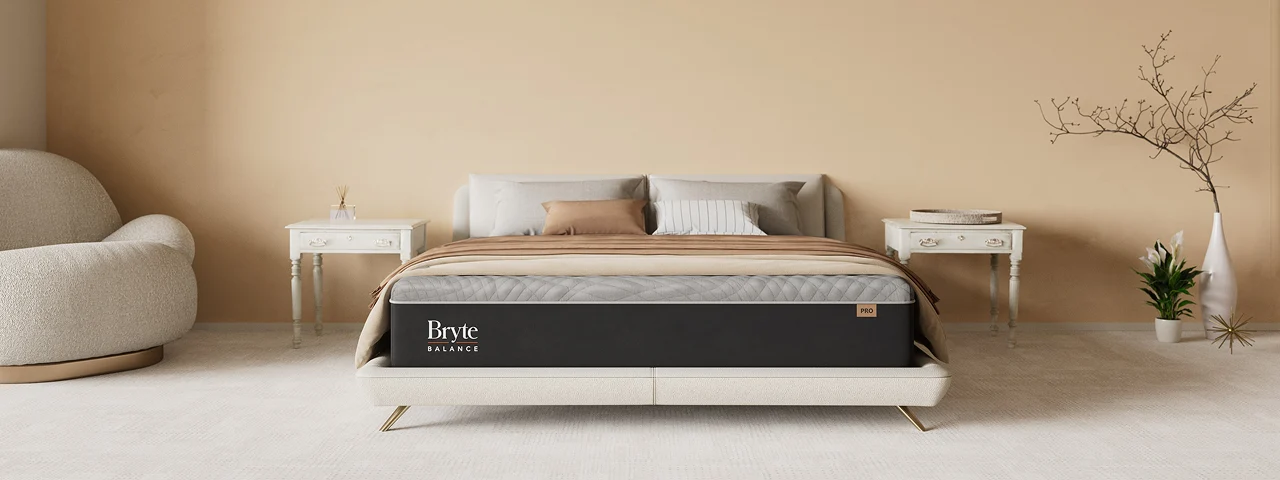
Consider replacing your mattress if:
- it shows visible sagging,
- is around 7 years old or older,
- or you regularly wake with back pain or stiffness that improves after you get moving.
In general, medium-firm surfaces tend to perform better for back pain than very firm ones, though individual fit still matters.
And if you sleep better in other beds or your mattress feels uneven, your sleep surface may be one contributor worth addressing.
Research on older mattresses suggests replacement can improve both back pain and sleep quality, especially when the old mattress has lost support.
Quick signs it may be time to replace your mattress
- Age: around 7+ years, or earlier if support has clearly degraded
- Sagging: visible dips or uneven support
- Pattern: pain is worst on waking and improves within 15–30 minutes
- Comparison: you sleep better in hotels, guest beds, or other mattresses
- Adjustment limit: a new mattress that still feels wrong after 30–60 nights may not be the right fit
How to Know if Your Mattress Is Causing Back Pain
Some people notice a pattern where morning discomfort improves after they get moving. Pain peaks immediately upon waking and improves within 15-30 minutes as you move and muscles warm up. This differs from injury pain, which typically eases with rest rather than activity.
Signs your mattress is the culprit:
- Pain is worst upon waking, improves after 15-30 minutes of movement
- Symptoms worsen the longer you stay in bed (sleeping in makes it worse)
- You sleep noticeably better in hotel beds, guest rooms, or other mattresses
- Frequent position changes during the night as you search for comfort
- Pain localizes to lower back, hips, or shoulders—common pressure point areas
The "sleep elsewhere" test: Spend 2-3 nights in a different bed. If pain resolves and returns when you're back on your mattress, you've isolated the cause.
This experience is echoed across Reddit communities. As one user shared on r/Mattress:
"I realized a lot of my prior shoulder pain was due to too firm mattress after I realized I always felt better during hotel stays."
Mattress Lifespan by Type: When Age Alone Justifies Replacement
General guidelines suggest mattresses last 7-10 years. But different materials degrade at different rates.
Source: Sleep Basil
For back pain sufferers, err toward the earlier end of these ranges. The correlation between mattress age and pain severity means degradation affects you before it affects someone without existing back issues.
One Reddit user on r/Mattress described this frustrating cycle:
"Absolutely. Everytime I get lower back pain I know it's time to get a new mattress. Problem is I only get about 18 months out of a mattress before support is lost."
Consumer behavior reflects this reality. The mattress replacement cycle has dropped from 9 years in 2020 to 8.3 years in 2022, and nearly half of consumers now replace within seven years.
The 1-Inch Rule: Sagging Thresholds That Signal Failure
Sagging represents structural failure—the mattress can no longer maintain the support it was designed to provide. Many warranties specify sag thresholds (often around ~1 inch, sometimes more), but the exact cutoff varies by brand and how sag is measured.
Sources: Sleep Foundation, Twilight Bedding
How to measure sagging at home:
- Remove all bedding to expose the bare mattress surface
- Place a straight edge (yardstick, broom handle) across the suspected sag area
- Measure the gap between the straight edge and the deepest point of the mattress
- Focus on high-use areas where shoulders, hips, and back typically rest
- Photograph with ruler visible for documentation
What Research Shows About Pain Reduction After Replacement
Clinical trials provide specific outcome data—not mattress company marketing claims.
Key findings:
- 48% pain reduction when participants replaced mattresses averaging 9+ years old with medium-firm bedding (PMC clinical trial)
- 63% of consumers reported reduced back pain after replacement (Sleep Zone)
- 55% sleep quality improvement in the same clinical trial
- 62.8% pain reduction and 58.4% stiffness reduction with medium-firm mattresses compared to overly soft or firm options (Best in Beds Australia)
The timeline matters too. Sleep quality improved by 24.2% from week 1 to week 4 alone. You don't need to wait months to know if replacement is working.
Real users have experienced dramatic results. One user shared their experience on r/Mattress:
"Super old post - I just slept on a new mattress and in 1 night a year of back pain is gone. I'm shocked. I'm a skinny guy, and I've always felt like a firm mattress was too firm for me since I was so skinny. So I bought a soft mattress about 4 years ago. It was great. Even had guests say it was the best night sleep they ever had, loved the mattress. About 1.5 years ago, my back started hurting. I thought it was because of a new job I had. Or just that I was getting old. Now I know. I was lucky I had a firm foam mattress from a previous mistake purchase. I just had it laying under my other mattress. Tested it out last night and my back pain is gone."
The Firmness Finding: Why "Firm for Back Pain" Is Wrong
Conventional wisdom says firm mattresses are best for back pain. Research says otherwise.
A randomized, double-blind trial of 313 adults with chronic low-back pain compared medium-firm mattresses (rated 5.6 on hardness scale) to firm mattresses (rated 2.3). Results:
In this trial, medium-firm was associated with better outcomes on the primary endpoints at 90 days, with the strongest evidence for disability and pain while lying in bed.
The mechanism: Firm mattresses force your body to conform to the surface, creating pressure points at hips and shoulders. Medium-firm provides enough resistance to prevent excessive sinking while allowing enough give for pressure relief.
Among 130 patients with back pain, 29.23% preferred medium firmness—the highest preference category. Significant differences in pain severity across firmness levels (p < 0.001) confirm this isn't just preference; it affects outcomes.
A user on r/backpain shared their painful lesson about going too firm:
"Medium. I went from soft to firm thinking it would help my back with a L5 S1 disc herniation. It left me in agony, 2 months of sleeping on it I developed sciatica! The physio told me it has to be soft enough for your shoulders and hips to sink in a little to ensure correct alignment of the spine. Mine was so firm I got a lot of hip pain because my hips couldn't sink in, and it's the widest part of my body so all the pressure went onto my hips. In the end I could only sleep for 2 hrs at a time before it became agony. My boyfriend is wider at the shoulders so he got shoulder pain sleeping on it. I've just bought a new mattress with more springs but also a thick memory foam layer, plus a decent memory foam topper (Panda). Last night was my first night in it and I slept 6 hrs as opposed to my usual 2-3 at a time. So I'm hoping that as I get used to it I'll go back to 7.5hrs sleep. If you try them in store ask an employee, or friend to check if your body looks straight when you lie on the mattress."
The Economic Case: What Poor Sleep Actually Costs
The comparison isn't "new mattress vs. free." It's "new mattress vs. ongoing costs of poor sleep."
Quantified costs of inadequate sleep:
- $1,967 per employee annually in lost productivity (Sleep-Disorders.net)
- $7,000 more per year in healthcare costs for those with sleep disorders—60% higher than those without (Mass Eye and Ear)
- $411 billion annually in U.S. economic losses from insufficient sleep (World Finance)
A mattress used nightly for 7 years represents approximately 2,555 nights. Even a $2,000 mattress costs $0.78 per night over that period. Compare that to ongoing productivity losses, increased healthcare utilization, or the compounding effects of chronic sleep deprivation.
The Decision Framework: How Many Signs Mean It's Time?
If two or more of these apply, replacement is justified:
- Mattress is 7+ years old
- Visible sagging exceeds 1 inch (1.5 inches for foam)
- Morning back pain improves within 15-30 minutes of waking
- You sleep better in other beds
- Frequent tossing and turning during the night
- Mattress surface feels uneven when lying down
Single indicators that justify immediate replacement:
- Sagging exceeds 2 inches
- Mattress is 10+ years old (regardless of other symptoms)
- Chronic pain following the mattress-related pattern (morning peak, improves with movement)
What to Expect After Replacement
New mattresses require 30-60 nights to break in. Memory foam may take up to 4 months due to dense construction.
Normal during adjustment:
- Initial firmness that softens over 2-4 weeks
- Temporary muscle adjustment as your body adapts to different support
- Sleep pattern changes as you find new comfortable positions
Not normal:
- Pain that worsens rather than gradually improving after 30 nights
- New pain in areas that weren't previously affected
- No improvement in morning stiffness after 60 nights
Most retailers offer trial periods specifically because adjustment takes time. Use the full trial before deciding.
When Pain Points to Something Other Than Your Mattress
Not all back pain originates from your sleep surface. Seek medical evaluation if:
- Pain persists throughout the day without improvement
- Pain worsens with activity rather than improving with movement
- Numbness or tingling radiates down the legs
- Pain doesn't follow the morning-peak-then-improvement pattern
- Chronic severe symptoms regardless of sleep surface
According to Baylor Scott & White Health, lack of mattress support can reinforce poor posture and strain muscles—but if symptoms don't match the mattress-related pattern, replacement alone won't resolve the issue.
Beyond Static Replacement: The Active Technology Option
Traditional mattresses degrade from day one. Foam compresses, springs lose tension, and support characteristics shift. This creates a predictable cycle: buy, degrade, suffer pain, replace.
The alternative is Active Pressure Relief.
Unlike static materials that passively wear out, Active Pressure Relief systems use real-time sensing and real-time adjustments to maintain support continuously, regardless of the mattress's age or your changing body.
What to Look For in an Active System If you are considering ending the replacement cycle with an active system, assess it on three critical metrics that determine its long-term effectiveness:
- Resolution (Precision): A system is only as good as its ability to target specific body parts.
- The Standard: Look for high-resolution systems. Bryte uses up to 90 independent cushions to support the hips and shoulders separately.
- The Risk: Lower-resolution competitors (often using a single air bladder) lift the whole body at once, which can misalign the spine.
- Response Time: Pain often strikes when you move and the mattress fails to catch you.
- The Standard: Bryte senses and adjusts within seconds.
- The Risk: Systems that only adjust once per hour leave you unsupported during critical position changes.
- Sound: The adjustment mechanism must be silent. If a system whirs or clicks while adjusting, it solves back pain only to create insomnia.
Bryte’s Approach
The Bryte Balance portfolio exemplifies this approach. The Bryte Adaptive Core contains up to 90 intelligent pneumatic Bryte Balancers organized into 16 independent zones (8 per sleeper). These sensors detect pressure imbalances and adjust firmness in real-time—before discomfort accumulates.
Features relevant to back pain sufferers:
- Individual Zone Control (PRO models): Adjust firmness in specific areas like the lower back
- Guided Comfort Tailoring: Suggests starting comfort settings based on user inputs and sleep data patterns
- Dual Comfort Design: Each partner controls their side independently (0-100 firmness scale)—no compromise required
- Over-the-air updates: Bryte OS improves the sleep experience over time rather than allowing degradation
For those who've experienced the cycle of mattress degradation → back pain → replacement → repeat, active technology offers a different relationship with sleep. The mattress maintains support through active adjustment rather than passive acceptance of wear.
Frequently Asked Questions
How do I know if my mattress is causing my back pain?
Mattress-related pain peaks in the morning and improves within 15-30 minutes of movement. Test by sleeping elsewhere for 2-3 nights—if pain resolves, your mattress is likely the cause.
Key diagnostic signs:
- Pain worsens the longer you stay in bed
- Frequent position changes during sleep
- Better sleep quality in other beds
How often should I replace my mattress if I have back pain?
Every 5-7 years, depending on mattress type. The average mattress age among back pain patients is 7.18 years, and pain severity correlates with mattress age.
By type:
- Innerspring: 5-6 years
- Memory foam: 6-7 years
- Hybrid: 6-7 years
- Latex: 7-8 years
How much mattress sagging is too much?
1 inch for innerspring, latex, and hybrid mattresses. 1.5 inches for memory foam. Sagging beyond 2 inches indicates severe failure requiring immediate replacement regardless of mattress age.
Will a new mattress actually help my back pain?
Research shows 48% pain reduction and 55% sleep quality improvement after replacing mattresses averaging 9+ years old. 63% of consumers report reduced back pain after replacement.
Improvement timeline:
- Week 1-4: 24% sleep quality improvement
- 30-60 nights: Full adjustment period
- Best results: Medium-firm mattresses (not firm)
Should I get a firm mattress for back pain?
No. Medium-firm outperforms firm mattresses for back pain. A clinical trial of 313 adults found medium-firm mattresses were 2.36x more effective for pain while lying in bed and 2.10x better for disability reduction compared to firm options.
What's the break-in period for a new mattress?
30-60 nights for most mattresses. Memory foam may take up to 4 months. Initial firmness is normal—materials need time to conform to your body. If discomfort worsens after 30 nights rather than improving, the firmness or material may be wrong for you.
Can a smart mattress help with back pain better than a traditional mattress?
Smart mattresses actively adjust to pressure imbalances rather than passively degrading over time. Systems like Bryte's zoned pneumatic design detect pressure changes and adjust support in real time, which is designed to reduce pressure-related sleep disruptions.
Content Disclaimer
This article is meant for informational purposes only and is not a replacement for clinical advice. Those with medical concerns or chronic pain are encouraged to seek professional healthcare assistance. Experiences detailed in this content are anecdotal and may not mirror the results of most individuals.
Shop Bryte Beds
From the Park Hyatt New York to Rosewood Miramar Beach, thousands of guests have experienced Bryte in the world’s top hotels—now it’s your turn.