Smart mattresses work by combining three technology layers:
- Embedded sensors that detect your body's pressure, movement, and biometrics in real time
- AI algorithms that interpret this data and identify when adjustments are needed
- Physical actuators that power Active Pressure Relief, silently changing the mattress surface to eliminate pressure points and optimize comfort while you sleep
That three-layer system is what separates a genuinely smart mattress from a traditional one.
A traditional mattress is static. It cushions the same way every night, regardless of what your body needs. A smart mattress, driven by Real-time Active Pressure Relief, senses those needs and immediately adjusts.
According to the National Sleep Foundation's 2025 Sleep in America Poll, roughly 60% of U.S. adults fail to get the recommended 7 to 9 hours of sleep. About 38% struggle to fall asleep multiple nights a week, and nearly 50% have trouble staying asleep. A mattress that can address those problems in real time is not a gadget. It is a health tool.
How a Smart Mattress Reads Your Body Without a Wearable
Most smart mattresses use ballistocardiography (BCG) sensors to track your body without requiring you to wear anything. BCG sensors are piezoelectric films or pressure-sensitive arrays embedded in the mattress that detect micro-vibrations from your heartbeat, breathing, and movement.
What BCG sensors measure:
- Heart rate. Your heartbeat creates a tiny mechanical wave that travels through your body into the mattress surface. BCG-based monitoring can approach 99% accuracy under controlled conditions.
- Respiratory rate. Breathing creates distinct, identifiable rise-and-fall patterns in the sensor data.
- Movement and body position. Tossing, turning, and sleep position changes are tracked continuously.
- Pressure distribution. Where and how much your body weight presses against the surface at any moment.
Not all sensor layers are equal. The critical factor is resolution: how many independent sensing points exist across the mattress. A system with one sensor zone per body half gives you a rough average. Bryte's technology uses 90 AI-powered Balancers organized into 16 independent zones, mapping pressure with enough precision to identify exactly where a pressure point is forming.
Active Pressure Relief: The Distinction That Defines the Category
This is the single most important concept in smart mattress technology, and most explanations skip it entirely.
Three tiers of mattress technology exist:
Active Pressure Relief means real-time sensing of pressure points combined with real-time adjustments. That "real-time" distinction is critical. If a mattress only adjusts when you tell it to, or adjusts once per hour on a schedule, it cannot prevent the pressure buildup that wakes you at 2 a.m. with hip pain.
This is exactly the kind of problem that passive materials cannot solve on their own. Foam degrades, springs lose tension, and the sleeper absorbs the consequences. Active Pressure Relief addresses this by continuously detecting and removing pressure points before they cause pain.
Three criteria tell you more about a smart mattress than any marketing claim:
- Sound. Adjustments must be silent. Noise defeats the purpose of a system designed to keep you asleep.
- Resolution. How many independent zones can sense and adjust? Bryte uses 90 Balancers across 16 zones. Lower-resolution systems may use a single air bladder per side, which can only raise or lower firmness for the entire body at once.
- Response time. How quickly does the system act? Bryte's Active Pressure Relief adjusts within seconds. Some competitors adjust only once per hour, which means pressure can build and cause pain long before the system responds.
Not all smart mattresses are alike. Some claim to be “smart” but only provide manual firmness adjustability, with no sensing, auto-adjustments, or active pressure relief (e.g. Saatva Solaire). Some include sleep tracking, but only have limited non real-time adjustments (e.g. Sleep Number).
How Accurate Is Smart Mattress Sleep Tracking, Really?
Skepticism about tracking accuracy is reasonable. The honest answer is nuanced.
The practical takeaway: smart mattress tracking is genuinely useful for identifying patterns over weeks and months. It is not a substitute for a clinical sleep study. The best systems, including Bryte's, are transparent about this. They position data as a foundation for personalized guidance, not a medical readout. That honesty is itself a trust signal.
This perspective is echoed by real users who have spent time with under-mattress tracking devices. As one owner shared on r/withings:
"It's not particularly accurate at distinguishing between sleep stages, but none of the non-EEG devices are - I compared it against the Apple Watch and it was no better. So if you want to know how much time you spend in deep sleep vs REM vs light sleep, don't expect it to give you useful answers. So why do I find it so useful? The overall sleep quality score very accurately tracks my own subjective assessment of how well I slept. It's reasonably good at measuring how long you slept and how often you were interrupted. The simple red/yellow/green system is intuitive and just works. The heart rate feature is very accurate and useful. When I was sick and had a fever, I could see exactly how much my heart rate went up relative to normal nights, and that helped me track how long it took for my fever to subside. The killer feature is that it's 100% ambient and requires no action from you whatsoever to track your sleep. I don't have to remember to wear anything, I don't have to open any apps to start the tracking - I don't have to do anything at all. Yet whenever I like, I can open the app and look back to see how well I've been sleeping."
Why Deep Sleep Matters and How Active Technology Protects It
Deep sleep (Stage 3 NREM) is the most physically restorative sleep stage. The Sleep Foundation recommends it comprise 10 to 25% of total sleep, roughly 40 to 110 minutes per night. During deep sleep, the body releases growth hormone, the immune system produces protective cytokines, and the brain consolidates memories. A 2024 study from Charite, Universitatsmedizin Berlin confirmed that deep sleep's slow waves directly strengthen synaptic connections involved in memory formation.
Every unnecessary awakening interrupts a deep sleep cycle. Pressure points are one of the most common mechanical causes. Active Pressure Relief addresses this directly. By silently detecting and removing pressure points before they register as pain, the mattress prevents the arousal that would cut a deep sleep cycle short.
For the separate problem of falling asleep, Bryte's BryteWaves technology synchronizes gentle, rhythmic motion within the mattress with curated audio like nature sounds or guided breathwork. This targets the physiological arousal that the AASM reports affects 74% of U.S. adults. Each partner can run independent BryteWaves sessions on their side.
Two Sleepers, One Bed: Couples, Privacy, and Reliability
ResMed's 2026 Global Sleep Survey of 30,000 individuals found that 80% of people in relationships report their partner disturbs their sleep. The AASM reports that 31% of U.S. adults now sleep separately. Bryte's Dual Comfort Design addresses this without separate beds. Each partner independently controls their side's firmness on a 0 to 100 scale, runs their own relaxation sessions, and views their own sleep data. Silent Wake Assist uses gradual motion to wake one person without disturbing the other.
The struggle of sharing a bed with a partner who has completely different firmness needs is one of the most common mattress complaints online. One user captured this dilemma perfectly on r/Mattress:
"I prefer a softer bed, he prefers firm. Currently we have a Costco select Casper, I can't remember which one but I think it is medium firm. Neither of us are happy with it - too firm for me and too soft for him. I do get lower back pain and hip soreness from this bed and roll around a lot. I feel like i'm going nuts looking at all the options."
What Data Does a Smart Mattress Collect?
A 2025 Copeland study found 52% of smart device owners don't understand what data is collected. Before buying any smart mattress, ask three questions:
- Is your data sold or shared with third parties?
- Is it de-identified before any commercial use?
- Can you export and delete it?
What If the Technology Fails?
The mattress retains its physical comfort properties independent of the active technology. The foam and structural layers function as a quality sleep surface even without active adjustment. Bryte backs every bed with a 10-year warranty.
What the Evidence Says Smart Mattresses Can Do
A 2024 clinical study from the Affiliated Hospital of Shaoxing University found AI pressure-redistributing mattresses reduced moderate-to-high-risk pressure injuries from 35% to 17% compared to standard equipment (p=0.036). That is a statistically significant, peer-reviewed result.
Independent reviews confirm the performance. NapLab rated the Bryte Balance PRO 9.01 out of 10, with a perfect 10 for pressure relief and 9.6 for motion isolation. WIRED highlighted the speed of personalization, noting most users settle into preferred settings after about one week. Trustpilot user reviews reference an average of 1,270 nightly adjustments per sleeper. That number makes the invisible visible: the mattress is actively working while you sleep, not passively waiting.
One Bryte owner described the real-world experience of those nightly adjustments on r/Bryte:
"I got my Bryte Balance Pro (king) almost two weeks ago. I've had issues for a number of years that when I lay in one spot for too long on my side, my hip begins to ache. Literally overnight, issue gone. Another thing: I used to wake around 3am nearly every night with a highly overactive brain! I didn't think a mattress would address that, but it has! My 3 AM wakings have reduced by about half, most of the times when I do, I can fall back asleep within a half hour rather than two or three hours! You would think that you would hear the compressors filling up and deflating the individual baffles throughout the night, but you do not! And also, unless you're really paying attention, you really don't feel the dozens if not hundreds of adjustments it does during the night. It's very subtle. Never a sudden inflating or deflating. I was a bit nervous to drop this amount of cash for a bed that I couldn't see in person first, but I'm so glad I took the chance!"
Honest limitations to know:
- Smart mattresses are not medical devices. They detect patterns, not diagnoses.
- Tracking accuracy has real ceilings. Trend data over weeks is more reliable than any single night.
- There is a learning curve. Expect about one week for the AI to calibrate to your body.
Frequently Asked Questions
Does a smart mattress replace a wearable sleep tracker?
For most people, yes. Research shows comparable sleep-wake accuracy. The advantage is that there is nothing to charge or wear. An integrated system like Bryte's adds the ability to physically act on the data it collects.
How long does it take to see results?
Most users notice improved comfort within the first week. AI personalization improves over several weeks as the system builds a baseline of your patterns.
What if my partner and I want completely different firmness?
Each side of a Bryte bed is fully independent. Different firmness (0 to 100), different zones, different relaxation sessions, different alarms. No compromise.
Are the adjustments noisy?
No. The Balancer system operates silently. The 1,270-plus nightly micro-adjustments happen without either sleeper noticing.
How is a smart mattress different from an adjustable bed?
An adjustable bed changes the angle of the sleep surface. A smart mattress with Real-time Active Pressure Relief silently detects and removes pressure points in real time across multiple independent zones. They solve different problems.
The Real Question
The sensor technology is validated. The AI personalization is measurable. The clinical evidence for Active Pressure Relief is statistically significant. What remains is a personal calculation: does your sleep quality matter enough to invest in a system that actively improves it, every night?
For the roughly 60% of adults whose sleep falls short, a mattress that silently detects and removes pressure points in real time, helps you fall asleep, protects your deep sleep cycles, and learns your body over time is not a luxury. It is a direct response to a real problem. The 100-night trial eliminates the traditional mattress buying uncertainty. You test the system with your body, in your home, over real weeks of sleep.
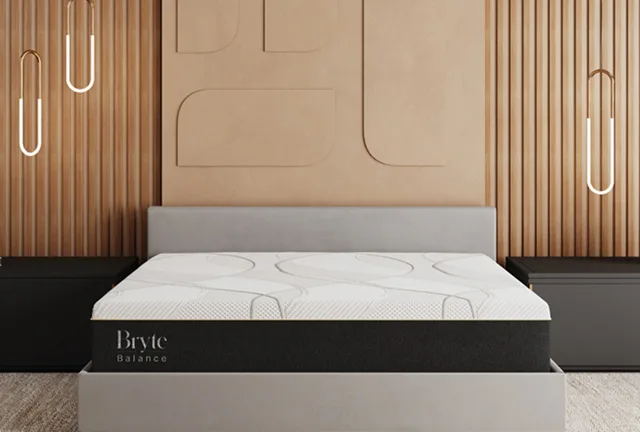
The Bryte Balance starts at $4,799 for a queen, with a 100-night trial and 10-year warranty.
Shop Bryte Beds
From the Park Hyatt New York to Rosewood Miramar Beach, thousands of guests have experienced Bryte in the world’s top hotels—now it’s your turn.